Photo Credit: Google.com
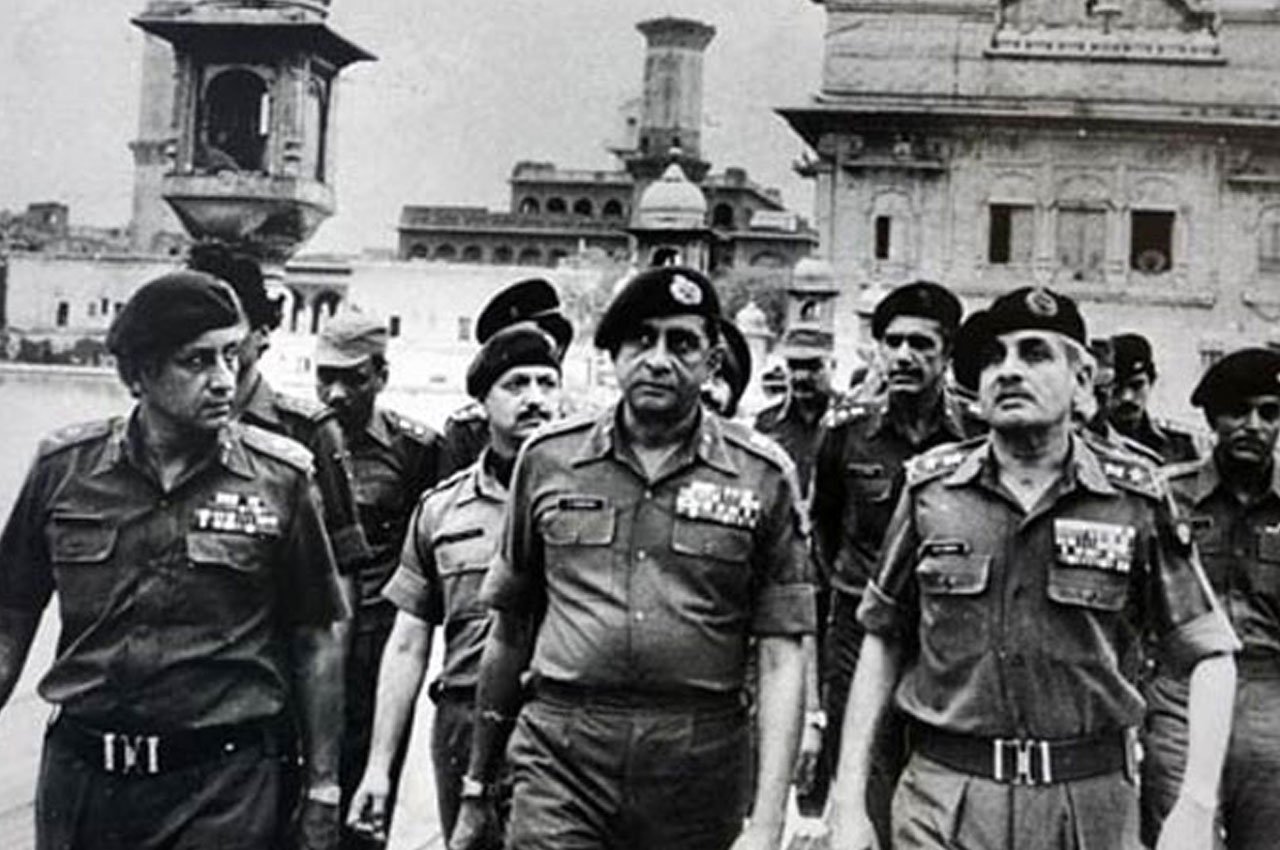
A striking revelation by retired General VN Sharma, former Chief of the Army Staff, has reignited the debate around the Indian Army’s controversial role in Operation Blue Star. Gen Sharma, who served as Additional Director General of Military Operations (ADGMO) in 1984, has disclosed that the MO Directorate had formally advised the then Army Chief, Gen AS Vaidya, against using the army inside the Golden Temple complex to flush out militants led by Jarnail Singh Bhindranwale.
This disclosure, which comes over four decades after the military operation shook the nation, is not just a historical footnote—it sheds light on the constitutional and ethical fault lines that existed within the armed forces in the days leading up to the fateful assault on the sacred Sikh shrine. Gen VN Sharma made these revelations during an interview aired on the YouTube channel Lex Consilium Foundation on June 5, 2025—precisely one day before the 41st anniversary of Operation Blue Star. This account was also reported by The Indian Express on June 9, 2025
Internal Dissent Before the Storm
According to Gen Sharma, senior officers within the Military Operations Directorate—including Lt Gen CN Somanna and Maj Gen VK Nayar—felt strongly that the army should not be involved in what was essentially a politico-religious crisis. Their argument rested on a constitutional principle: the armed forces are trained for external threats, not internal policing, especially within religious sites.
Sharma claims that Gen Vaidya was advised to refer the matter either back to the Prime Minister’s Office or even to the Supreme Court, underlining that a purely military solution could backfire both strategically and morally. But despite this internal resistance, the plan moved ahead.
Gen Sundarji’s Involvement and the Final Orders
Once political clearance was granted by Prime Minister Indira Gandhi, Gen Vaidya is said to have distanced himself from the operation’s tactical planning. Instead, Gen K Sundarji, then the Western Army Commander, was entrusted with the execution. The 9th Infantry Division was deployed—an unusual choice, as it included Sikh soldiers, raising concerns over emotional strain and conflict of interest.
Major General Kuldip Singh Brar, a Sikh officer himself, was brought in to lead the on-ground execution, reportedly to lend credibility and maintain a semblance of religious sensitivity. The operation, however, ended with devastating consequences: significant civilian casualties, damage to the Akal Takht, and a deep scar on India’s secular fabric.
Echoes in Present-Day Controversies
This revelation comes in the wake of a new row involving Operation Sindoor, where the Indian Army claimed it had acted with the Golden Temple’s approval to neutralize drone threats. The Shiromani Gurdwara Parbandhak Committee (SGPC) swiftly denied this, calling it a breach of religious protocol and warning against the military’s repeated encroachments into religious affairs.
The timing of Gen Sharma’s statement has lent greater weight to such concerns, as public memory of Operation Blue Star remains raw, especially in Punjab. Historians and political analysts argue that these patterns reflect a continued tension between national security mandates and religious sentiments—a friction that successive governments have struggled to navigate.
Lessons From the Past: The Constitution as Compass
What stands out in Gen Sharma’s account is not just the operational detail but the deep commitment to constitutional propriety within sections of the army. The MO Directorate’s objection was not rooted in fear or indecisiveness—it was a principled stand rooted in the Indian military’s traditional apolitical posture.
This episode also raises uncomfortable questions. Could Operation Blue Star have been avoided or delayed had this advice been heeded? Would a police or paramilitary-led operation have been less damaging in terms of civilian life and religious alienation?
There are no easy answers. What remains, however, is a stark reminder of the long-term costs of militarising internal conflicts, especially those laced with religious identity and political symbolism.
Final Thought
As India continues to face complex security challenges—both external and internal—it is crucial to remember that the strength of a democracy lies not just in its military might, but in its ability to restrain that might when needed. The voice of caution from within the Army’s own operational leadership in 1984 speaks volumes about the institution’s moral compass—a compass that must remain true, especially when navigating the minefields of religion and politics.