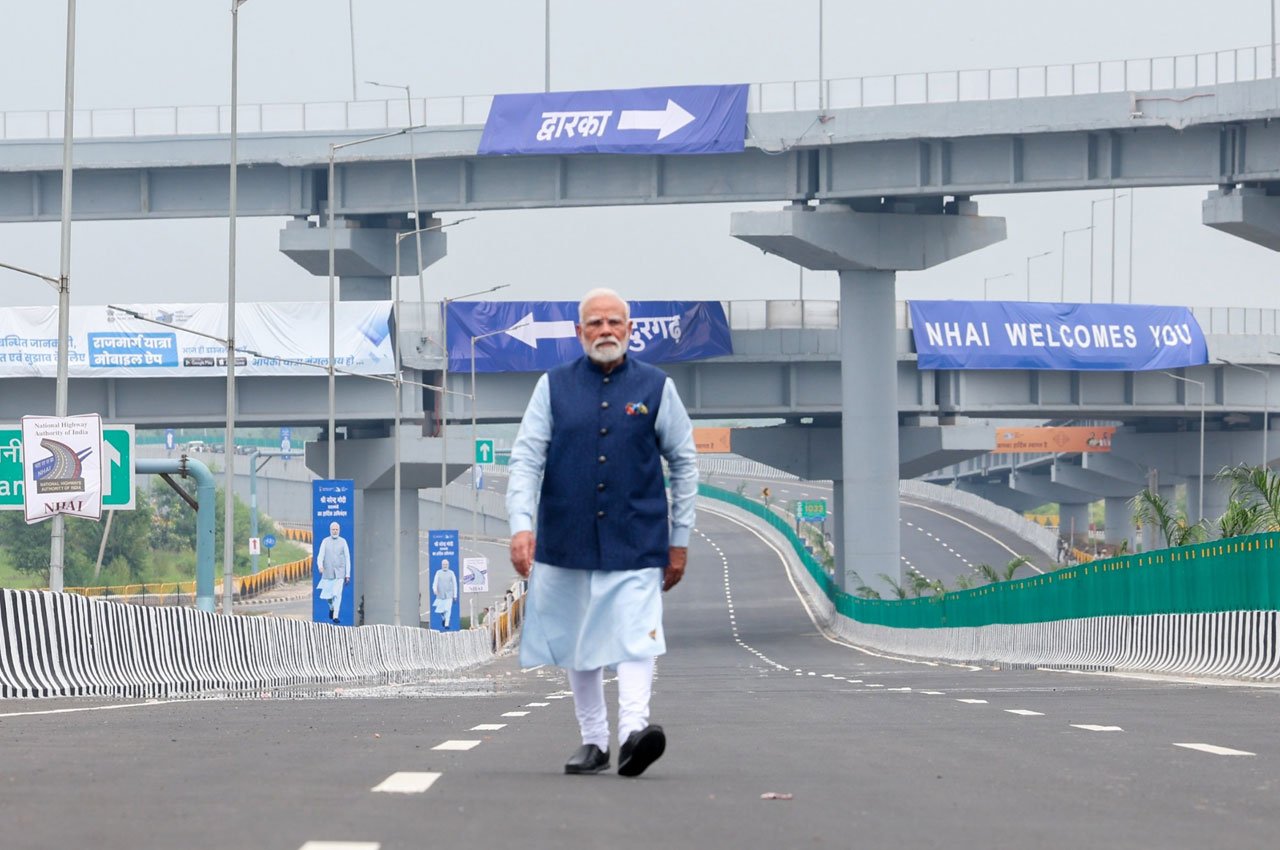
In a major infrastructure push, Prime Minister Narendra Modi inaugurated two significant National Highway projects in Delhi-NCR today, collectively valued at nearly ₹11,000 crore. According to The Hindu, the event, held in Rohini, aims to dramatically reduce traffic congestion and enhance urban mobility across the capital region.
Projects Overview
The two projects mark a milestone in Delhi’s transport infrastructure. The first is the Delhi Section of the Dwarka Expressway, spanning 10.1 km and developed at a cost of approximately ₹5,360 crore. This stretch has been designed to improve multi-modal access by linking the Yashobhoomi Convention Centre, Delhi Metro’s Blue and Orange lines, the upcoming Bijwasan railway station, and the Dwarka cluster bus depot. It is divided into two packages: a 5.9 km stretch from the Shiv Murti intersection to the Dwarka Sector-21 Road Under Bridge, and a 4.2 km stretch up to the Delhi-Haryana border that connects directly with the Urban Extension Road-II.
The second project, Urban Extension Road-II (UER-II), is Delhi’s third ring road. It stretches nearly 76 km and has been developed at an estimated cost of ₹5,580 crore. Starting from Alipur, it passes through Bawana, Rohini, Mundka, Bakkarwala, Najafgarh, and Dwarka, before ending at Dichaon Kalan. The project also includes important spurs to Bahadurgarh and Sonipat to facilitate industrial and commercial connectivity. Officials say it will reduce the traffic burden on Delhi’s existing Inner and Outer Ring Roads and ease pressure on choke points such as Mukarba Chowk, Dhaula Kuan, and NH-9. Travel time between Indira Gandhi International Airport and parts of southwest and northwest Delhi is expected to reduce by up to 60 percent.
Environmental and Social Impact
The projects have been developed with a strong focus on sustainability. For UER-II, over one million metric tonnes of inert waste material from the Bhalswa and Ghazipur landfills were recycled, turning the project into a model of waste-to-wealth innovation. Environmental measures also included large-scale tree transplantation, silt removal from the Yamuna river, and measures to reduce vehicular pollution by minimizing long traffic snarls. These steps, officials emphasized, are expected to significantly cut air pollution levels in Delhi-NCR.
Political Resonance and Official Remarks
At the inauguration ceremony, Prime Minister Modi described the projects as transformative, not only for Delhi but for India’s infrastructure growth. He highlighted the symbolic significance of the names “Dwarka” and “Rohini” where the inauguration was held, linking them with Lord Krishna and Janmashtami festivities. Modi said Delhi represents the face of a developing India, and the world assesses the country’s progress through the capital’s infrastructure and growth indicators.
He underlined the government’s long-term focus on “ease of living,” recalling his Independence Day address where he had promised a model of urban transformation. The Prime Minister stressed that the last decade has seen unprecedented progress in building connectivity and that these projects are part of a larger vision to make India’s infrastructure world-class.
Union Transport Minister Nitin Gadkari, Delhi Chief Minister Rekha Gupta, and Haryana Chief Minister Nayab Singh Saini were also present at the event. Gadkari said the new corridors would be a game-changer for commuters and trade alike, adding that they reinforce the government’s vision of sustainable and modern infrastructure.
Public Engagement and Roadshow
Before the inauguration, Prime Minister Modi conducted a roadshow at the Mundka-Bakkarwala Village Toll Plaza. He interacted with local residents and greeted construction workers who were part of the project. The roadshow generated enthusiastic public participation and added a human touch to what was otherwise a highly technical milestone.
What This Means for Delhi-NCR
The two projects are expected to bring immediate and long-lasting relief to commuters and businesses. They will decongest key roads, improve travel time to the airport, and reduce fuel wastage caused by long traffic jams. Industrial hubs around Bahadurgarh and Sonipat are expected to benefit from faster goods movement, while residents of northwest and southwest Delhi will enjoy easier access to city centres. Beyond mobility, the projects also stand out for their innovative use of waste material and environmental safeguards, offering a model for future urban projects across India.
For more stories click here
Follow us for latest updates: