In a significant legal development, a Chhattisgarh NIA court has granted bail to two Kerala-based Catholic nuns, Preethi Merry and Vandana Francis, who were arrested last week on allegations of human trafficking and religious conversion. The case also involves Sukaman Mandavi, a tribal youth from Narayanpur, who was taken into custody along with the nuns. The arrests had triggered widespread outrage across Kerala, with political leaders, church authorities, and civil society organisations terming the move a violation of constitutional rights and religious freedom.
According to The Hindu, the court, presided over by Principal District and Sessions Judge Sirajuddin Qureshi in Bilaspur, passed the bail order on August 2. The trio was granted bail on a personal bond of ₹50,000 each with two sureties. Additional conditions include the surrender of passports, a ban on traveling abroad, and strict instructions not to contact witnesses during the investigation.
While the prosecution opposed the bail plea, claiming that the investigation was still at a preliminary stage, the court noted that the FIR itself was based on suspicion and that the investigating agency had not sought custodial interrogation. The court observed that no prima facie evidence had been established to prove forced religious conversion or human trafficking.
The Arrest and Allegations
The incident dates back to July 25 when the two nuns and Sukaman Mandavi were detained at Durg Railway Station while accompanying three young tribal women from Narayanpur. A Bajrang Dal functionary filed a complaint alleging that the women were being trafficked to Agra and were being forcibly converted to Christianity. Based on this complaint, the trio was arrested and booked under the Chhattisgarh Religious Freedom Act (1968) and relevant provisions of the Bharatiya Nyaya Sanhita (BNS) related to human trafficking.
According to the defence, the women, all adults, were traveling voluntarily for training and employment at a nursing institute in Agra. The parents of the women have reportedly stated that they were already practicing Christians and had sent their daughters with full knowledge and consent.
Kerala Erupts in Protest
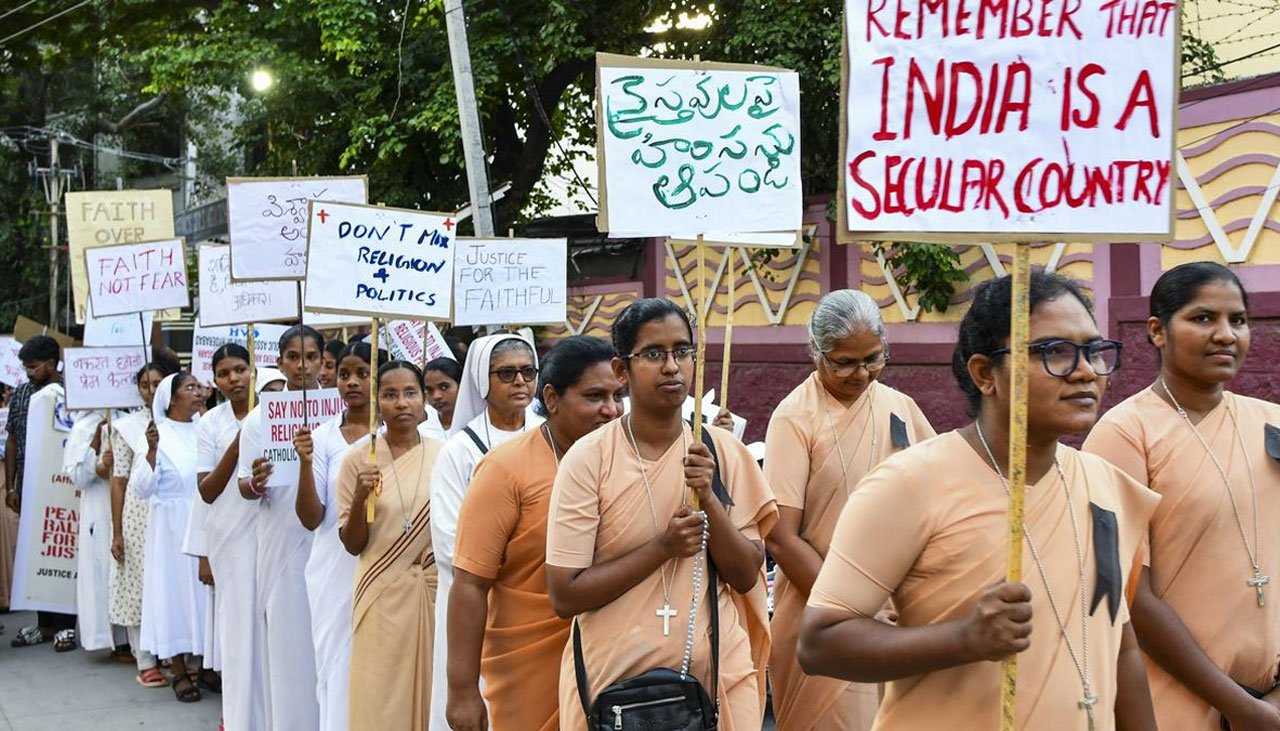
The arrests sparked a massive outcry in Kerala. Political leaders across the spectrum condemned the move, calling it an attack on minority rights. The Congress-led UDF raised the issue in Parliament, while Left leaders blamed right-wing forces for targeting Christian missionaries and institutions.
The Catholic Bishops’ Conference of India (CBCI) and other church bodies also took strong exception to the arrests. Archbishop Andrews Thazhath, President of CBCI, met senior BJP leaders in Kerala, urging them to ensure justice. Archbishop Joseph Pamplany also appealed to the Centre to intervene, citing that such arrests could demoralize thousands of Christian missionaries engaged in social and educational work across India.
The Kerala BJP leadership, meanwhile, took a more conciliatory tone. BJP state president Rajeev Chandrasekhar termed the incident a “misunderstanding” and said the matter needed to be resolved with sensitivity. He also supported the release of the nuns, diverging from the hardline stance often associated with the issue of religious conversions.
Legal Defence and Court Observations
Amrito Das, the counsel representing the nuns, argued that the FIR lacked any solid foundation. He maintained that the women involved were not minors and had been traveling of their own will. The court appeared to agree with this assessment, noting that neither the statements of the women nor those of their parents supported the claim of coercion or inducement.
The defence further highlighted that the accused had no criminal background and were engaged in long-standing social work. The court’s observations that custodial interrogation was not even sought by the police significantly weakened the prosecution’s case.
Nationwide Debate on Religious Freedom and Conversion Laws
The case has reignited the debate over the use and misuse of anti-conversion laws in India. While several states have enacted laws to regulate religious conversions, activists and legal experts argue that these are often used selectively against minorities, particularly Christians and Muslims, involved in charitable or social outreach.
A silent protest in Belagavi, Karnataka, saw nearly 400 Christians demanding the unconditional release of the nuns. Protesters submitted a memorandum to district officials, asserting that the arrests were based on mere assumptions and lacked legal or factual merit.
What Lies Ahead
Although the bail order offers temporary relief to the accused, the investigation is still ongoing. The NIA will continue to probe the case, and the nuns must adhere to strict bail conditions until the matter is resolved in court.
More broadly, the case has underscored the fragile balance between state law enforcement, religious freedom, and civil liberties. As India continues to grapple with questions of identity, secularism, and minority rights, cases like this one may well define the contours of future legal and political discourse.
Photo Credit: The Hindu
For more spotlight stories click here
Follow us for latest updates: