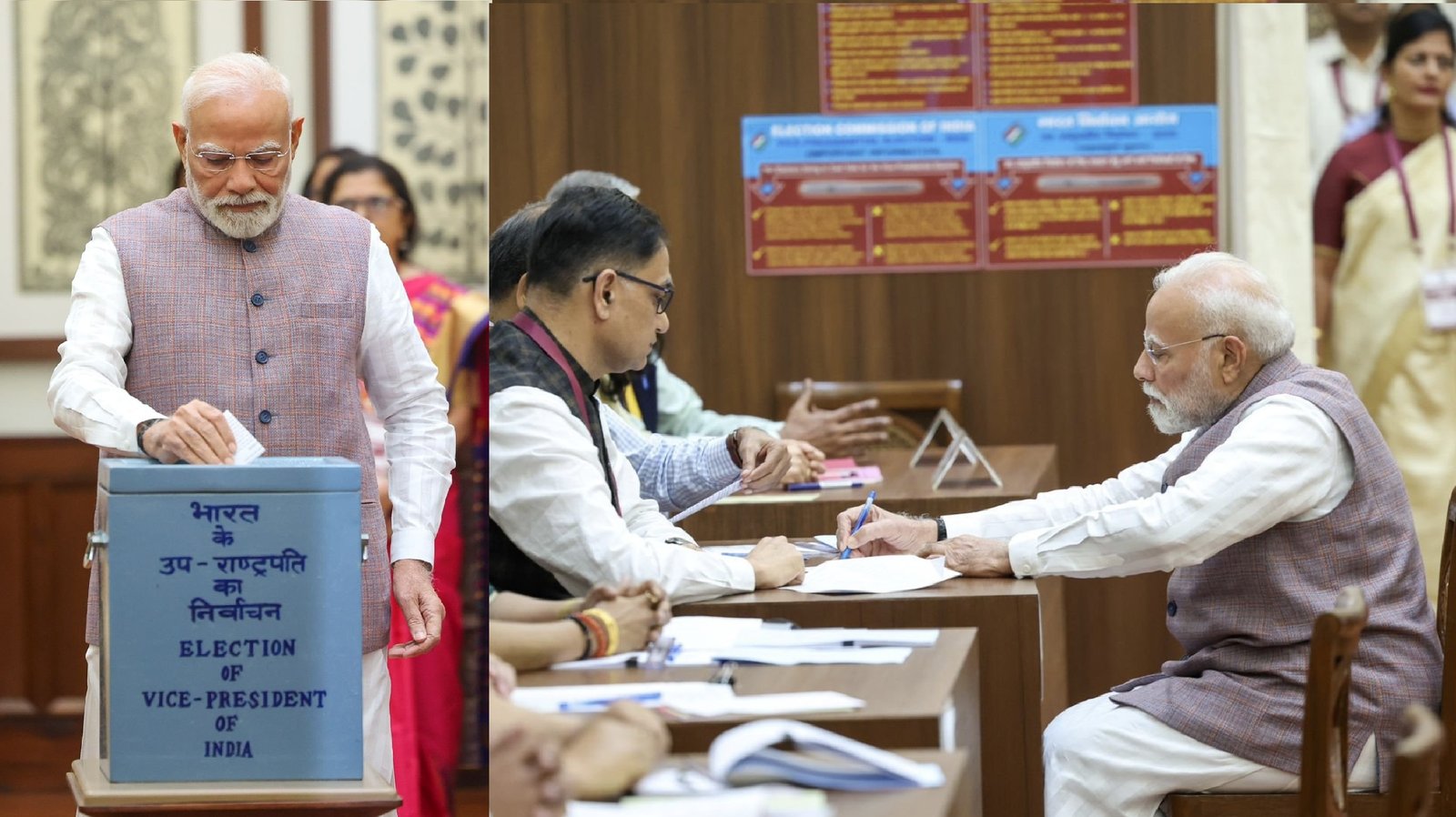
India is in the midst of a high-stakes vice-presidential election following the unexpected resignation of Jagdeep Dhankhar on July 21 due to health issues. Voting began today at 10 a.m. and will continue until 5 p.m., with counting set to start at 6 p.m. Results are anticipated later this evening.
Prime Minister Narendra Modi made history by being the very first to cast his vote, setting the tone for a precedent-setting contest and highlighting the significance of the occasion. This symbolic act underscored the importance that the ruling coalition places on a smooth and decisive process.
The electoral battle pits the ruling National Democratic Alliance’s nominee, C P Radhakrishnan, against the INDIA bloc’s candidate, B Sudarshan Reddy. Radhakrishnan, the current governor of Maharashtra and a veteran BJP leader from Tamil Nadu, enjoys the backing of a broad coalition. Sudarshan Reddy, a former Supreme Court judge from Telangana, represents the opposition’s push for judicial independence and democratic values.
This marks the first vice-presidential election in which both top contenders hail from southern India—a rare and meaningful turn in the nation’s political narrative, reflecting the region’s growing prominence on the national stage.
The electoral college includes members of both Parliament houses, including nominated members of the Rajya Sabha. MPs cast their secret ballots under a single transferable vote system, which ensures proportional representation by allowing voters to rank candidates in order of preference. If no candidate reaches the required quota on first preference counts, the candidate with the fewest votes is eliminated and second preferences are redistributed until someone crosses the threshold.
Despite this nuanced voting mechanism, the NDA holds a commanding numerical edge. With roughly 425 MPs supporting Radhakrishnan and additional support from smaller parties, the alliance is well positioned to cross the 391-vote majority mark comfortably. The INDIA bloc retains 324 MPs, and parties such as AIMIM have pledged support to Sudarshan Reddy. Several regional parties, including BRS, BJD, and Shiromani Akali Dal, are abstaining—effectively lowering the total vote count and indirectly enhancing NDA’s advantage.
Preparation for the election has been thorough. Both sides conducted internal briefings and mock voting sessions to minimize errors during the actual ballot. These exercises emphasized the secret ballot’s importance, the need to mark preferences correctly, and adherence to electoral procedures.
The election stems from the constitutional provision requiring a vacancy in the vice-presidential office—due to resignation, removal, or death—to be filled promptly. The Election Commission announced the poll schedule on August 1, with nomination scrutiny, withdrawal deadlines, and polling logistics all finalized by late August.
As the day unfolds, the nation watches closely. The NDA’s numerical advantage makes Radhakrishnan the clear favorite, but the INDIA bloc has staked its appeal on principle over party loyalty, presenting Reddy’s candidacy as a stance for integrity, institutional respect, and judicial temperament.
This election is noteworthy not just for its numbers but for its symbolism. Two southern leaders, representing contrasting visions—one administrative and partisan, the other judicial and ideological—have now stepped into the spotlight. The final result will not only produce India’s 15th Vice President but will also reflect the evolving contours of region, representation, and democratic ethos in contemporary India.
Photo Source: X
For more stories click here
Follow us for latest updates: