Photo Credit: The Better India
In the small village of Awankhed, Maharashtra, a remarkable story of passion and invention is taking root. Seventeen-year-old Aditya Pingale, a high school student, has designed KrushiBot, a low-cost, mobile-controlled robot built from scrap. This innovation is already easing the strenuous lives of farmers in his community and making waves as an empowering example of rural ingenuity and young-led agri-tech solutions.
From Empathy to Innovation
Aditya’s founding inspiration stemmed from watching his uncle return home daily with a heavy 20-litre pesticide tank strapped to his back. Witnessing the toll that physical labor and chemical exposure took on his uncle’s body created a resolve in Aditya that something had to change. He envisioned a device that could take over this burden—and KrushiBot was born.
This inventive spark was fuelled by the support he found at school: participation in a robotics and STEM programme and access to real-world training through the Salaam Bombay Foundation. While still a class IX student, Aditya developed a vision for a mobile-controlled platform that could navigate fields and spray pesticides, avoiding the ecological and physical hazards of backpack spraying.
Building KrushiBot Without a Lab
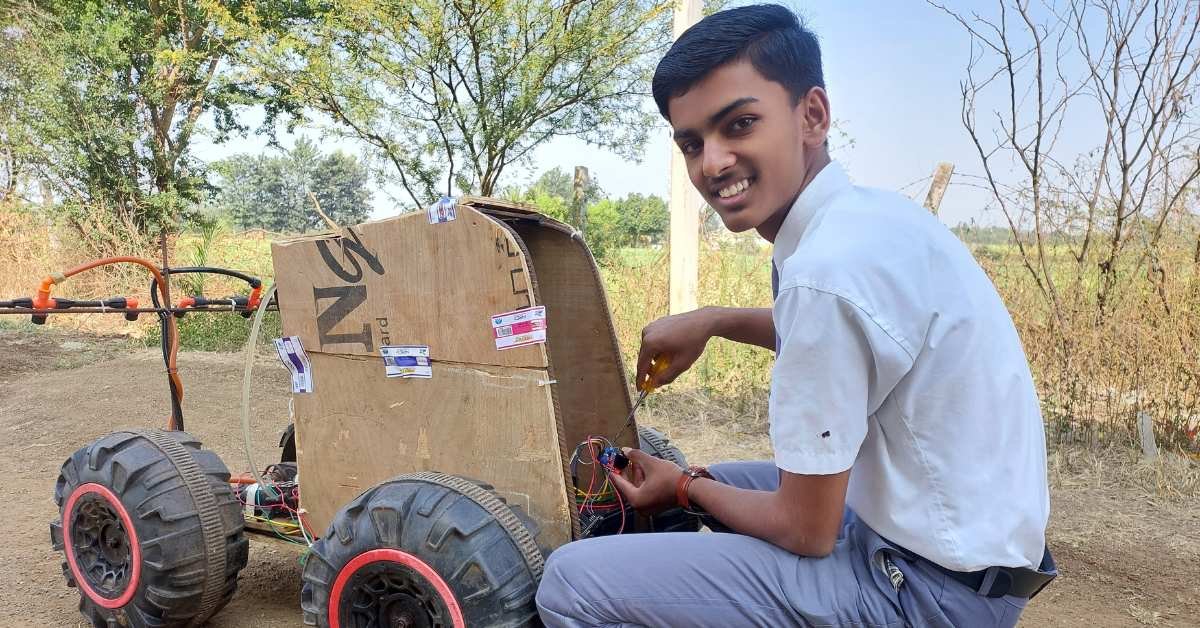
Unfettered by a lack of formal training or research facilities, Aditya tapped into brilliant resourcefulness. With encouragement from his father, who taught him welding and mechanics, and help from close friends, he built the first prototype from locally sourced scrap materials. It used a toy-car battery, recycled wheels, and a Wi‑Fi-enabled NodeMCU microcontroller that could be controlled via mobile phone. A 16-litre tank, 360-degree camera, and adjustable sprayer nozzle completed the setup.
Although the early versions were too heavy and underpowered, Aditya learned from every failure. He rebuilt the device multiple times, refining parts, reducing weight, and improving mobility. His tenacity paid off: by integrating recycled materials and adopting clever engineering workarounds, he created a practical machine that now works reliably in his uncle’s grape fields and grandfather’s mint plantation.
Real-World Impact
KrushiBot’s results have been dramatic. Tasks that took over an hour now take less than sixty minutes, and farmers no longer need to carry heavy loads through uneven terrain. Beyond physical relief, there is a reduction in pesticide waste and improved operational efficiency. His uncle’s words capture the spirit: “It is safer, quicker, and I don’t even have to walk through the field.”
By making the process safer, more dignified, and far less exhausting, Aditya’s innovation is giving back the dignity of work to farmers.
Recognition and Scale-Out Plans
Aditya’s work has earned him a spot in tech showcases such as Goa’s LEGO League and regional innovation contests. When he faced transportation issues due to KrushiBot’s size, he ingeniously redesigned it to fold and travel more easily. His invention now runs three hours on a single charge and can recharge in under 40 minutes—crucial features for practical rural use.
Looking ahead, Aditya plans to manufacture additional units and distribute them free to farmers in need. He aims to evolve KrushiBot into a multi-functional device capable of grass-cutting, pest control, and irrigation tasks. The vision is clear: a suite of affordable, locally built, farmer-friendly robots created by young minds who know the land.
Empowering Rural Problem-Solvers
By building KrushiBot, Aditya not only solved a problem—he also inspired a community. His story demonstrates how youth in rural India can combine empathy, grit, and local knowledge to innovate at scale. It also underscores the importance of community programmes that nurture scientific curiosity and hands-on design, even in settings with limited resources.
Aditya’s journey sends a powerful message: meaningful innovation does not require high-tech labs or healthy funding. What it requires is empathy, creative thinking, community backing, and tenacious iteration.
Final Word
As KrushiBot rolls through the fields of Maharashtra, it brings more than just mechanical assistance. It carries hope—for farmers, rural communities, and ambitious youth across India. In a world where complex innovation is often equated with big cities and big funds, Aditya Pingale’s success is a gentle yet powerful reminder that impactful solutions often emerge from the soil of empathy, resourcefulness, and youthful courage.