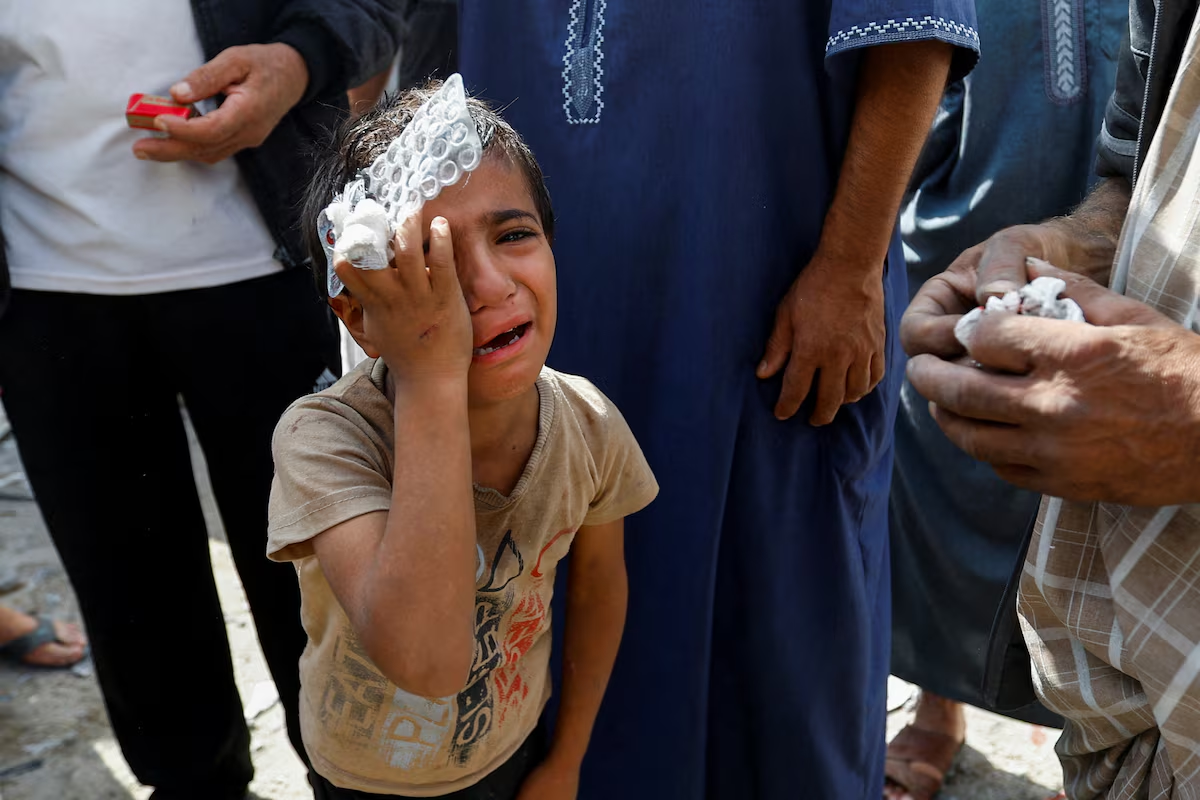
Innocence Under Fire: Gaza’s Children Trapped in Conflict. Photo Credit: Reuters
History often runs in circles, and the same applies to nations born out of trauma. The tragedy of the Jews under Hitler’s Nazi regime was one of the most devastating events of the 20th century. Six million Jews were persecuted and exterminated in gas chambers, labelled as subhuman, and blamed for Germany’s decline. It was a story of unchecked power, dehumanization, and silence of the world. From the ashes of that genocide rose a demand for a homeland – one where Jews could live in peace, dignity, and safety. That dream culminated in the birth of Israel in 1948.
But in a strange twist of fate, Israel today finds itself playing a role dangerously close to the oppressor it once fled from.
The logic that drove the creation of Israel was rooted in fear: never again would Jews be at the mercy of another nation. It was meant to be a refuge for a people who had lost everything. But that logic, over time, mutated into exclusionary nationalism – Zionism in its more extreme form. Today, the people who were once victims of ethnic cleansing are accused of inflicting systemic violence and denial of basic rights on another group: the Palestinians.
In 1967, Israel’s stunning military victory in the Six-Day War changed the map—and the mindset. It occupied Gaza and the West Bank, gaining not just land but millions of Palestinians who were not Israeli citizens. Unlike conventional conquests that integrate the defeated population, Israel kept Gaza and the West Bank under its control without offering full citizenship. This decision was not administrative—it was demographic. Granting full rights to Palestinians would tip the electoral balance, risking the dilution of Jewish political dominance in Israel.
This is where the predator-prey syndrome begins to manifest. The Jews, long persecuted by Europe, emerged as survivors. But survival, when driven by fear and hardened by trauma, can turn into aggression. For decades, Gaza has remained an open-air prison – controlled borders, restricted movement, limited access to resources, and repeated military strikes. The predator has now become the prey, and the prey the new predator.
In 2005, Israel formally withdrew its settlements and troops from Gaza. But control never truly ended. Airspace, sea access, and borders remained in Israeli hands. Gaza was left isolated, its elected government – Hamas deemed a terrorist organisation by Israel and many Western countries. The blockade that followed turned Gaza into one of the most densely populated and impoverished regions on Earth.
What followed over the years was a cycle of provocation and punishment. Rockets from Gaza, retaliatory airstrikes by Israel. Civilian casualties on both sides. But the numbers speak volumes: the scale and intensity of Israeli firepower on Gaza has consistently resulted in disproportionately high Palestinian civilian deaths. In recent years, Israel’s approach has grown even more unapologetic. Prime Minister Benjamin Netanyahu’s leadership has been marked by an increasingly hardline, ultranationalist approach, bolstered by a generation that has only known Israel as a regional military power.
The youth in Israel today have grown up in a militarised, securitised society. The trauma of the Holocaust is not lived experience – it is history. What they have seen instead is a strong, powerful Israel, battling ‘enemies’ on its borders. The lines between defense and domination have blurred. The grief that once united Jews globally has been transformed, in some circles, into anger and entitlement.
And in this toxic cocktail of trauma and nationalism, the victim-prey dynamic gets reversed. The hunted becomes the hunter. The cycle of vengeance replaces the spirit of justice. The response to the horrors of the past becomes a justification for silencing the present.
The most disturbing element is this: the tactics used by the Nazis – collective punishment, blockades, ghettos, control over movement and resources, are now being mirrored in Gaza, albeit under different justifications. The gas chambers may not exist, but the suffering of an entire population under siege is undeniable. This is not a comparison meant to equate atrocities, but to reflect on how the trauma of a people can, if not acknowledged and processed properly, turn into an ideology of superiority and exclusion. The predator-prey syndrome is not unique to Israel. History is replete with examples