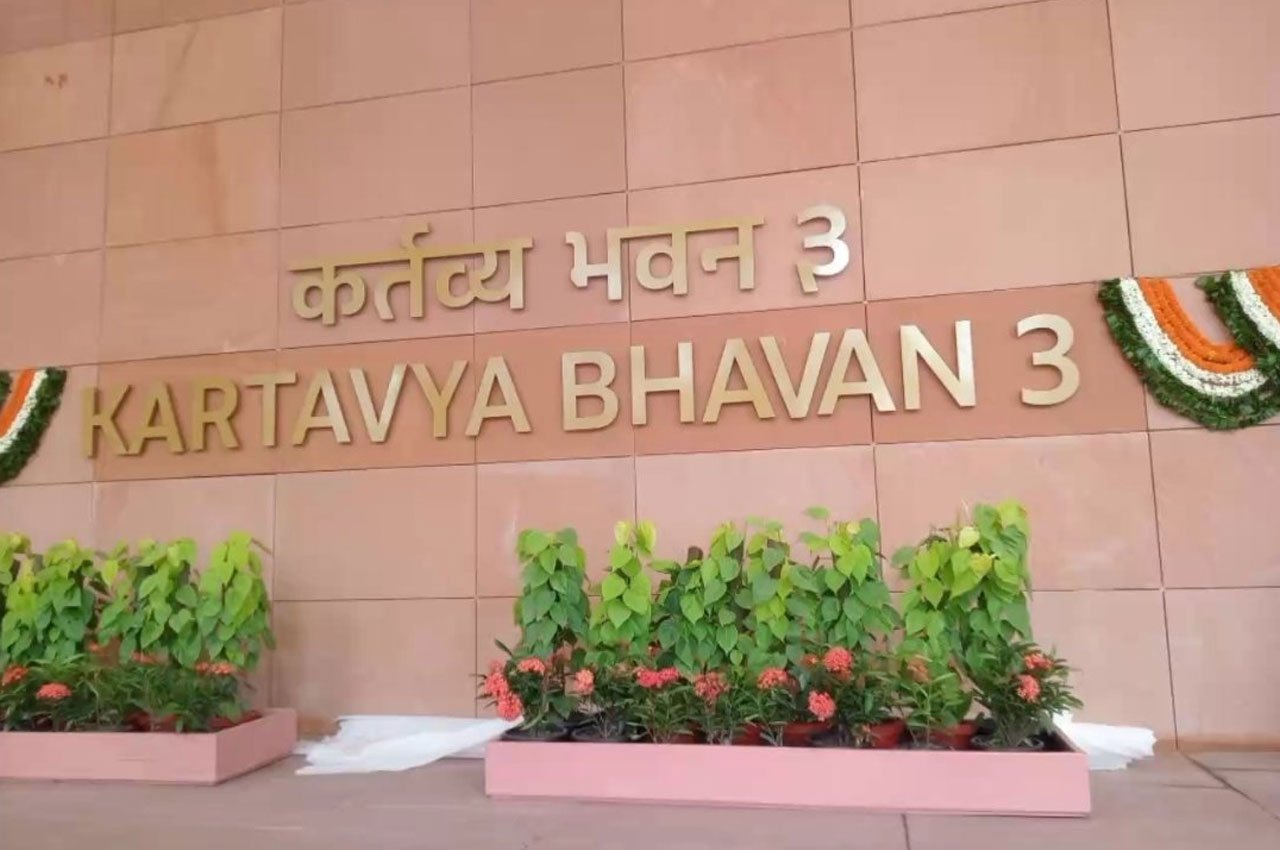
In a major push towards administrative modernization, Prime Minister Narendra Modi inaugurated Kartavya Bhavan-3, the first of ten new Common Central Secretariat buildings under the ambitious Central Vista redevelopment project. According to Hindustan Times, designed to streamline governance and enhance inter-ministerial coordination, the building is set to house several key ministries and departments in the heart of New Delhi.
The inauguration marks a significant milestone in the transformation of the capital’s administrative core. The project aims to replace aging colonial-era buildings like Shastri Bhawan, Udyog Bhawan, and Krishi Bhawan with integrated, smart, and sustainable office spaces that reflect the scale and speed of modern governance.
Kartavya Bhavan-3: The New Nerve Centre
Kartavya Bhavan-3 spans approximately 1.5 lakh square metres across seven floors and two basement levels. The structure is equipped with modern amenities and has a parking capacity of over 600 vehicles. Among the ministries moving into the new complex are Home Affairs, External Affairs, Rural Development, MSME, Petroleum & Natural Gas, the Department of Personnel and Training (DoPT), and the office of the Principal Scientific Adviser to the Government of India.
These ministries, previously scattered across multiple old buildings, will now operate under one roof. This consolidation is expected to not only improve efficiency but also cut down the high maintenance costs of older structures that are no longer equipped to handle the demands of today’s fast-paced bureaucracy.
Green Building for a Green Future
Sustainability has been placed at the core of Kartavya Bhavan’s design. The building aims to achieve a GRIHA-4 rating, reflecting its commitment to environmental responsibility. The structure is built to save up to 30 percent of energy consumption compared to conventional office buildings.
To achieve this, the complex includes double-glazed facades for thermal insulation, solar panels expected to generate over 5.3 lakh units of electricity annually, and a solar water heating system. Rainwater harvesting, LED lighting, and power-saving smart lifts have also been installed. Electric vehicle charging stations and an in-house zero-discharge waste treatment facility further strengthen its eco-friendly credentials.
Designed for Efficiency and Well-Being
Kartavya Bhavan-3 goes beyond mere office space. It has been designed to create a productive and inclusive work environment. The building features a medical clinic, yoga and wellness room, crèche facilities for working parents, a café, a multipurpose hall, and nearly 120 meeting and conference rooms.
Access to different parts of the building is regulated through a smart card-based entry system, ensuring controlled and secure movement. The architecture also emphasizes natural lighting, open workspaces, and collaborative zones – hallmarks of modern office design.
Concerns Over Open-Plan Layout
Despite the futuristic approach, the building has not been without its critics. Officers from the Central Secretariat Service (CSS) have expressed concerns over the open-plan layout of the offices. They fear that the lack of physical partitions and dedicated cubicles could compromise the confidentiality of sensitive files and hamper the secure handling of classified government documents.
While the government has assured that secure zones will be integrated within the layout, the transition from traditional workspaces to open-plan designs is likely to involve a period of adjustment for many bureaucrats.
What Lies Ahead in the Central Vista Project
Kartavya Bhavan-3 is only the beginning. The Central Vista redevelopment plan envisions ten such Common Central Secretariat buildings that will gradually become the administrative backbone of India’s central government. The next structure, CCS-2, is expected to be completed by September 2025, followed by CCS-10 in April 2026 and CCS-6 and CCS-7 by October 2026.
In later phases, the government plans to develop an Executive Enclave that will include the new Prime Minister’s Office, Cabinet Secretariat, India House, and the National Security Council Secretariat. A new prime ministerial residence is also proposed as part of the larger reimagining of Delhi’s power corridors.
Redefining Governance for a New India
The inauguration of Kartavya Bhavan-3 is not just about bricks and mortar. It symbolizes India’s commitment to building a future-ready governance ecosystem. The project reflects a shift in how government offices are viewed – not merely as functional spaces, but as enablers of a more agile, efficient, and responsive administration.
As ministries begin to move into their new offices, Kartavya Bhavan-3 stands as a testament to India’s changing governance architecture – modern, sustainable, and forward-looking. The Central Vista project, though not without its share of debate, continues to reshape the administrative identity of New Delhi in a way that reflects the aspirations of a rising global power.
Photo Source: X
For more trending stories click here
Follow us for latest updates: