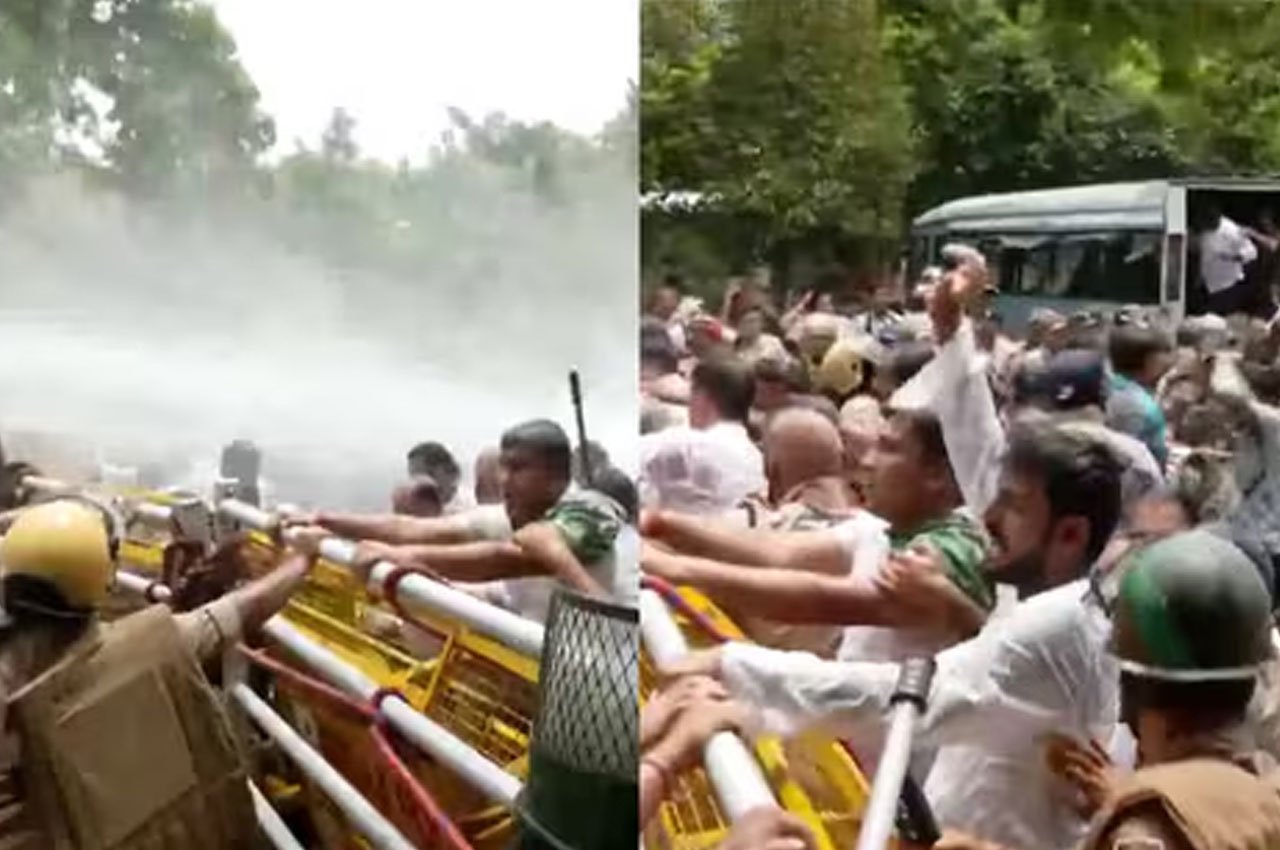
A massive protest in Odisha over student self-immolation erupted in Bhubaneswar as opposition parties, activists, and students demanded justice for a 20-year-old college girl from Balasore who set herself on fire after allegedly facing sexual harassment. According to Hindustan Times, Police deployed water cannons and detained several protesters amid a Balasore Bandh, highlighting the intensifying political and public outrage over campus safety failures.
The young woman, a second-year B.Ed. student at Fakir Mohan Autonomous College, had allegedly raised complaints against a professor for sexual harassment. Her repeated attempts to seek institutional support reportedly went unaddressed. In an act of desperation, she self-immolated on campus. Despite being rushed to the Balasore district hospital and later transferred to AIIMS Bhubaneswar, she succumbed to her injuries on July 15.
In response, the Odisha Governor, also Chancellor of state universities, demanded a full report from the Higher Education Department. The University Grants Commission (UGC) constituted a four-member fact-finding panel to investigate the institutional handling of the case and broader issues of campus grievance mechanisms.
Political tempers flared as the ruling BJP came under fire from opposition parties. The Biju Janata Dal (BJD) called for a Balasore Bandh, demanding the resignation of the Higher Education Minister and a judicial probe into the incident. Party workers, students, and civil society groups blocked roads, staged protests outside the Odisha Assembly, and raised slogans calling for justice.
In a show of force, police used water cannons to disperse the crowds, and several protesters were detained. Despite the crackdown, the protests gained momentum, especially as public anger mounted over the perceived apathy in handling the student’s initial complaints.
Congress leaders, including Rahul Gandhi, termed the incident as a systematic failure rather than an isolated suicide. Speaking with the student’s grieving family, Gandhi described the incident as “a murder by the system.” Odisha CM Mohan Charan Majhi called the act tragic and assured strict action against those found guilty. The government announced an ex-gratia payment of ₹20 lakh to the victim’s family and has suspended the accused professor and the college principal.
Meanwhile, the Chief Minister said a Special Investigation Team (SIT) would look into the case, and systemic reforms would be introduced to strengthen anti-harassment redressal systems in higher education institutions.
The case has sparked a wider debate on institutional accountability, with critics arguing that arresting individuals is not enough. Women’s rights groups and student organisations across India are now calling for mandatory grievance redressal audits in all colleges and universities. They are also demanding that the UGC enforce stricter implementation of its guidelines on sexual harassment prevention.
The student’s death has become a rallying point for opposition unity in Odisha, with the BJD and Congress both targeting the BJP government for alleged administrative failure. Simultaneously, the government has accused the opposition of politicising a tragedy.
Beyond politics, however, the incident has resonated deeply with students and women across the country. Social media is flooded with hashtags demanding justice, and candlelight vigils have been held in several college campuses to honour the deceased.
As Odisha braces for continued demonstrations and bandh calls, the government is under immense pressure to not only ensure justice for the victim but also to demonstrate structural changes that can prevent such tragedies in the future. For the people of Balasore and beyond, the demand is not just for action—it’s for accountability, safety, and a system that listens before it’s too late.
Photo Credit: HT
For more spotlight stories click here
Follow us for latest updates: