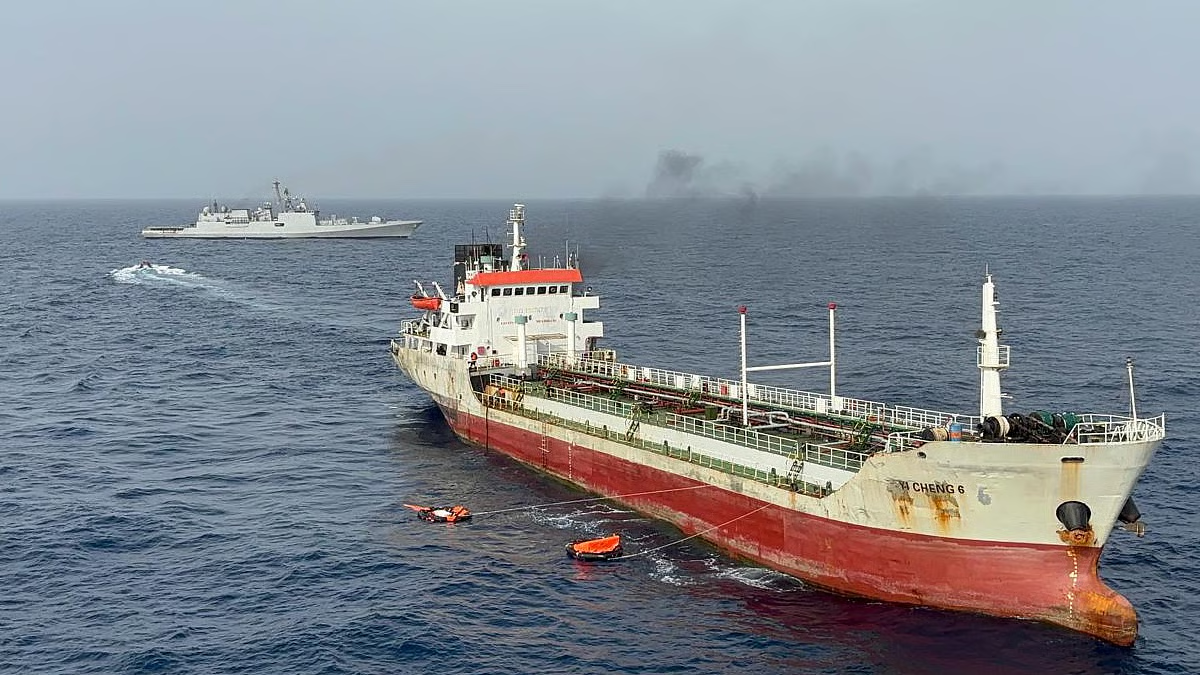
Oil Tanker Catches Fire in Gulf of Oman. Photo Credit: Baird Maritime
The Indian Navy’s stealth frigate INS Tabar displayed exceptional operational readiness and swift crisis response by leading a daring rescue operation after an oil tanker caught fire in the Gulf of Oman. The vessel, MT Yi Cheng 6, flagged under Palau, was en route from Kandla to Shinas in Oman when it suffered a major engine room blaze and a complete power failure, putting all 14 Indian-origin crew members at grave risk.
As reported in Baird Maritime, at around 9:30 a.m. local time on June 29, the crew sent out a distress call. INS Tabar, which was deployed in the region for maritime security operations, immediately responded. Its crew launched a rescue operation involving a firefighting team, rigid hull inflatable boats (RHIBs), and an onboard helicopter. Thirteen Indian Navy personnel boarded the distressed tanker and worked alongside five of the tanker’s crew members to contain the fire and stabilize the situation.
The fire in the engine compartment had threatened to engulf the vessel entirely, but the Indian Navy’s prompt action ensured that the flames were brought under control. The firefighting team was able to isolate the fire, restore partial power, and stabilize critical systems on board, thereby averting a full-scale disaster.
This timely intervention highlights the Indian Navy’s commitment to maritime security and humanitarian assistance, particularly in high-risk international waters like the Gulf of Oman. With all 14 crew members safe, the operation is being praised as a textbook example of naval efficiency and bravery.
INS Tabar, part of India’s Western Naval Command, has been actively involved in multiple maritime security missions including anti-piracy operations and commercial vessel support in international shipping lanes. The ship is equipped with state-of-the-art sensors, firefighting systems, and damage control mechanisms, all of which were deployed in this successful rescue.
This operation comes amid increasing incidents of maritime emergencies in the region, underlining the importance of naval preparedness and international coordination. The Gulf of Oman, a key maritime route for energy and cargo transport, frequently sees traffic from oil tankers and cargo ships bound for the Middle East, South Asia, and beyond. A major fire on such vessels could have far-reaching consequences—not just in human terms, but also economically and environmentally.
The rescue effort also aligns with India’s maritime doctrine, which emphasizes “Security and Growth for All in the Region” (SAGAR). Indian naval assets have been increasingly deployed to safeguard both Indian nationals and global maritime interests. In recent months, India has responded to multiple emergencies involving Indian seafarers, cementing its image as a dependable maritime power.
While the cause of the fire onboard MT Yi Cheng 6 remains under investigation, the safe evacuation and stabilization of the vessel underscore the importance of continuous crew training, rapid response drills, and international naval cooperation.
For the families of the crew back in India, the operation has brought immense relief. The successful rescue demonstrates that Indian naval forces are not only strategically placed but also deeply committed to the safety and well-being of Indian citizens abroad, even in the most perilous circumstances.
Follow us for latest updates: