Before Bollywood became the behemoth it is today, and before Madras and Calcutta found their cinematic voices, there was Lahore, the unexpected yet glorious nerve centre of Indian film production in the pre-Partition era.
Yes, you read that right.
Lahore, often celebrated for its rich poetry, sizzling kebabs, and cultural tapestry, was also home to one of the most thriving film industries in undivided India. From its glittering theatres to its pioneering producers, Lahore’s celluloid dream burned bright, until history changed everything.
The First Flicker: Silent Films in Lahore
Cinema tiptoed into Lahore as early as 1924, when G.K. Mehta, a former officer with North-Western Railways, imported a camera from London and produced The Daughters of Today.
A young A.R. Kardar starred in the film and assisted Mehta behind the scenes. He would later become a titan of Pakistan’s film industry after Partition.
Back then, Lahore wasn’t just watching cinema – it was building it from the ground up.
A Punjabi Debut Like No Other
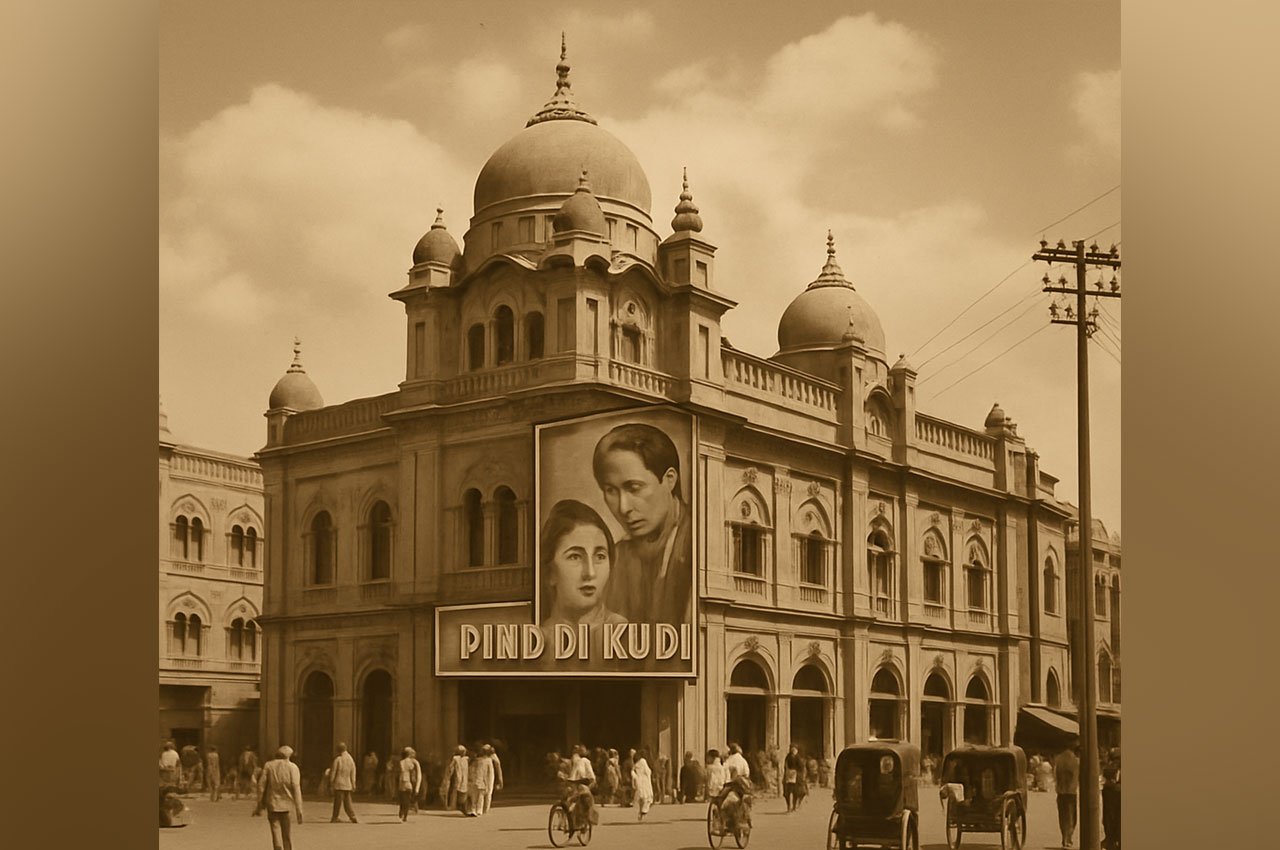
The first attempt at making a Punjabi film in Lahore came in 1934 with Heer Ranjha, but the project was derailed due to technical and financial hurdles. The breakthrough came a year later, in 1935, when K.D. Mehra created Pind Di Kudi, the first Punjabi-language film.
It wasn’t just a hit – it was a cultural phenomenon. The film launched the legendary Noor Jahan, who would go on to mesmerise generations with her voice and presence, later becoming known as Mallika-e-Tarannum in Pakistan. She sang, she acted, and she captivated an entire subcontinent.
The City of Nine Theatres
By the 1920s, still within the silent film era, Lahore boasted nine operational theatres, more than any other city in India at the time. And these were not just places to watch movies – they were arenas of social drama. From rickshaw pullers to royalty, everyone found a shared space under the flickering light of cinema reels.
In Lahore, the magic of cinema was more than entertainment. It was a cultural revolution playing out on screen, and in the streets.
Why Lahore? Why Not?
While Bombay, Calcutta, and Madras entered the film scene early, Lahore had its own powerful edge. The city’s linguistic fluidity – with Punjabis speaking both Hindustani (a blend of Hindi and Urdu) and Punjabi – offered broad accessibility for audiences across northern India.
Calcutta leaned towards highbrow art and literary cinema. Madras was deeply rooted in its Tamil heritage. But Lahore sat comfortably between cultural depth and mass appeal, offering relatable stories, evocative music, and lyrical scripts that could travel beyond its borders.
Lahore’s Celluloid All-Stars
As Lahore’s cinematic pull grew stronger, so did its constellation of talent. D.M. Pancholi, a Gujarati entrepreneur, established modern studios in the city. Himanshu Rai, who would later co-found Bombay Talkies, started his journey right here.
Many future stalwarts of Indian cinema had their roots in Lahore’s film scene.
B.R. Chopra, who gave Indian cinema the timeless Naya Daur and Indian television the epic Mahabharat, was then editing a film magazine called Cine Herald.
Ramanand Sagar, best known for creating the beloved Ramayan television series, was reporting for The Evening News.
They were not yet legends. They were dreamers, writing and directing their way through a golden era that was just beginning.
Partition: When the Curtain Fell
In 1947, the Partition of India tore through not just maps and communities, but also cultural landscapes. For Lahore’s film industry, it was an emotional and economic gut-punch.
As Lahore became part of Pakistan, chaos erupted. Pancholi Art Pictures and Shorey Pictures, two of the city’s most significant studios, were burnt down during communal violence. Most Hindu directors, producers, actors, and technicians had to flee. Bombay and Calcutta became their new homes, but something intangible was lost – a shared creative spirit that had once defined Lahore’s screen culture.
A Phoenix Called Lollywood
In the wreckage, something new began to stir. Pakistan’s film industry, later dubbed Lollywood, started rebuilding itself from the embers left behind. Without funds, equipment, or trained personnel, it was a cinema built on sheer grit.
A.R. Kardar, who had once acted in Lahore’s first film, emerged as one of the key architects of this new wave. Noor Jahan also chose to stay, lending her voice and stardom to the birth of Pakistan’s cinematic identity.
It wasn’t easy. But like all great stories, the struggle made it memorable.
Legacy of a Lost Capital
Today, the legacy of Lahore in Indian cinema remains under-celebrated. The city is rarely mentioned when recounting the rise of Bollywood or the milestones of Indian film history.
But make no mistake – Lahore wasn’t a side character. It was the protagonist. It nurtured the stars, laid the foundations, and rolled the cameras when few others dared to.
Its fall was tragic. Its contribution, unforgettable.
Lahore was more than just a city. For a brief and brilliant time, it was the beating heart of Indian cinema’s golden beginning.
For more entertainment stories click here
Follow us for latest updates: