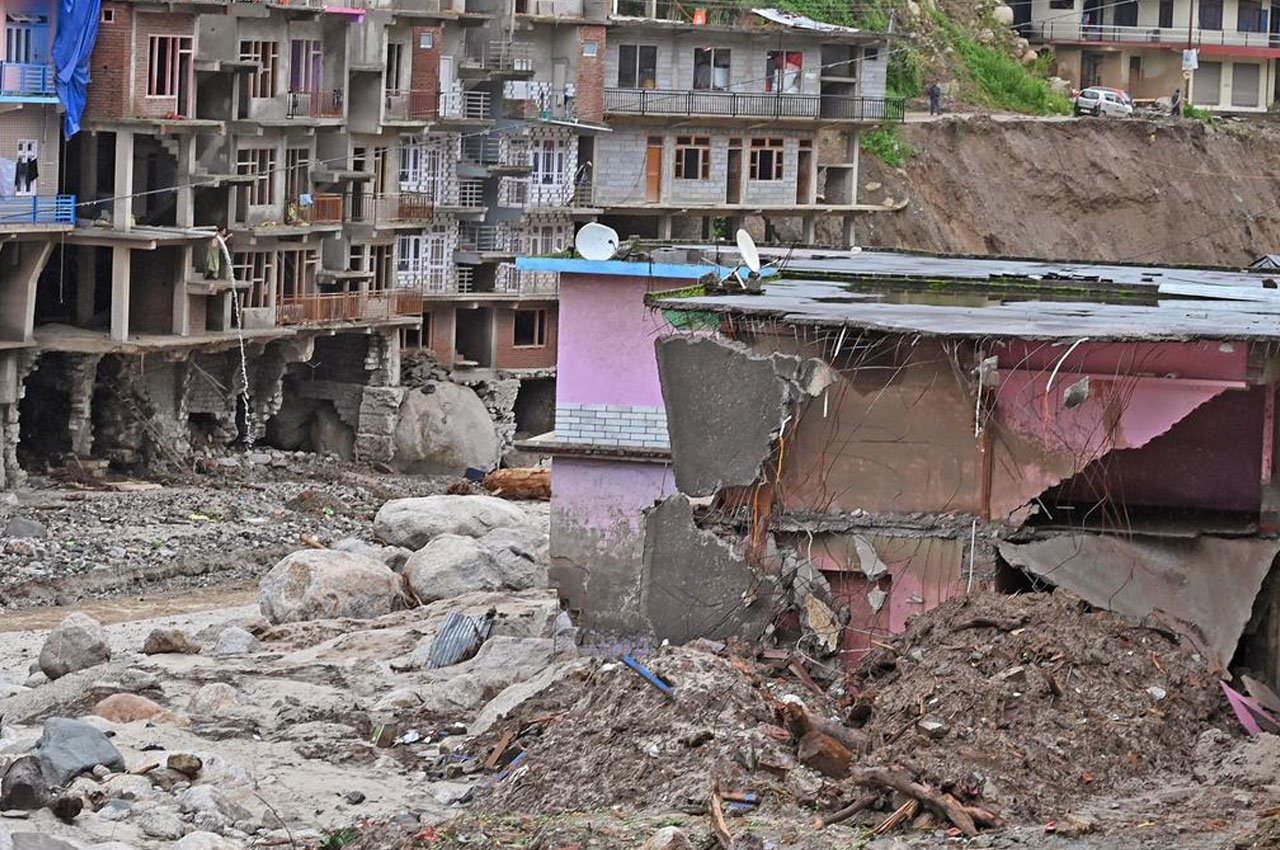
Photo Credit: PTI
The Himachal Pradesh Forest Department has filed a criminal complaint against the National Highways Authority of India (NHAI), alleging gross negligence in road construction work that led to a devastating landslide near Shimla, according to The Indian Express . The landslide, which struck on June 30, affected the Kaithlighat–Dhalli stretch of the Kalka–Shimla highway, causing massive ecological damage, collapsing a five-storey building, and threatening nearby residential areas.
Negligent Road Cutting Causes Widespread Damage
The FIR was submitted by Forest Officer Ajeet Kumar under Sections 32 and 33 of the Indian Forest Act and Section 324(5) of the Bharatiya Nyaya Sanhita. The complaint accuses NHAI of faulty and unscientific hill-cutting practices that destabilized the slope and triggered the landslide.
The forest department estimates that more than 8,550 square meters of protected forest land were damaged and that the total ecological loss is worth over ₹2.14 crore. Trees were uprooted, slopes were destabilized, and the natural drainage system was compromised due to unregulated excavation and debris dumping.
Building Collapse Raises Alarm
One of the most dramatic consequences of the landslide was the collapse of a five-storey building in the Bhattakufer area. The building’s owner, Ranjana Verma, reported that cracks had started appearing weeks before the disaster, which intensified after heavy monsoon showers. She blamed the landslide directly on deep, vertical excavation work being carried out by NHAI contractors.
Following the collapse, nearby homes were evacuated as fresh cracks began to appear in walls and floors. Locals claim repeated complaints to authorities fell on deaf ears, and now many are left without shelter or compensation.
Fourth FIR in a Week Against NHAI
This is the fourth FIR filed against NHAI in Shimla district in just one week. Earlier complaints included allegations of illegal debris dumping, endangering public safety, and threats to local residents. In one incident, Panchayati Raj Minister Anirudh Singh was also named in a counter-FIR by NHAI workers, accusing him of assault during an inspection.
Minister Singh, however, maintains that he was confronting NHAI officials over their negligence and that the FIR against him was politically motivated. The series of FIRs points to deepening friction between state authorities and central agencies over unregulated infrastructure work in fragile Himalayan zones.
Experts Warn of Environmental Collapse
Environmentalists and policy experts have raised concerns over the unchecked development in ecologically sensitive areas like Shimla. Many argue that large-scale road widening projects, such as the Kalka–Shimla four-laning, are being executed without sufficient geological surveys or ecological safeguards.
Experts have pointed to increasing incidents of landslides, deforestation, and water source depletion in areas where such projects are active. They advocate for the use of nature-based slope stabilization techniques, improved drainage systems, and strict oversight to prevent future tragedies.
A recent report on the ecological impact of the Kalka–Shimla highway expansion highlights the increased risk of landslides, soil erosion, and forest fragmentation. Activists say the Himachal tragedy is a direct consequence of warped development priorities that prioritize speed and scale over sustainability and safety.
Public Outcry and Demands for Action
The forest department has named the project director of NHAI’s Shimla unit in its FIR, but no arrests or formal action have been taken yet. Residents and civil society groups are calling for an immediate halt to all ongoing highway construction until an independent ecological audit is conducted.
Locals are also demanding fair compensation, relocation assistance, and legal accountability for damages. With monsoon season intensifying, concerns are mounting about further landslides and continued risks to life and property.
Why This Matters
Shimla and other regions of Himachal Pradesh have become increasingly prone to landslides during the monsoon. In 2023 alone, over 9,600 houses were damaged due to extreme weather events, and more than 170 landslides were recorded in the state.
This latest disaster serves as a wake-up call for governments at all levels. Without urgent reforms in infrastructure planning, environmental assessment, and disaster preparedness, such tragedies may become routine. The FIR against NHAI could mark a turning point—but only if it leads to real accountability and systemic change.
For more regional stories click here
Follow us for latest updates: