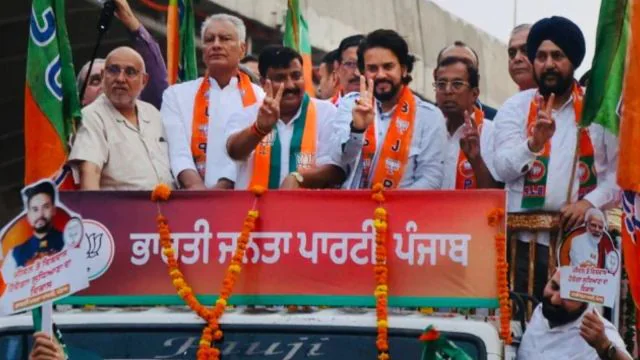
Photo Credit: Indian Express
In the 2024 Lok Sabha elections, the Bharatiya Janata Party (BJP) recorded a significant 18.56% vote share in Punjab—more than doubling its tally from the 2022 state polls. Yet, despite this rising support, the party continues to face a political paradox: increased votes, but no real gains in legislative seats. The recent Ludhiana West by-election, sharply reinforced this contradiction.
While the BJP has achieved dominance in several states across India, Punjab remains a tough nut to crack, a region that continues to resist the saffron surge. As BJP eyes the 2027 Assembly elections, the Ludhiana West result underscores how much work remains.
Rising Vote Share, But Nowhere Near Power
Since severing ties with the Shiromani Akali Dal (SAD) in 2021, the BJP has been steadily working to build an independent base in Punjab. From a modest 6.6% vote share in the 2022 Assembly polls, it surged to 18.56% in the 2024 Lok Sabha elections. The party led in 23 Assembly segments and performed relatively well in urban areas like Ludhiana, Jalandhar, and Patiala.
Yet, despite this, the party did not win a single Lok Sabha seat in Punjab. Its vote share, while promising on paper, failed to convert into actual victories – raising serious questions about the party’s ability to convert popularity into power.
Ludhiana West By-election: A Reality Check
The Ludhiana West Assembly constituency, considered an urban BJP-friendly zone, presented an opportunity to translate national vote share into a tangible win. BJP’s candidate Ravneet Singh Bittu had polled over 45,000 votes from this Assembly segment – more than any other party during Lok Sabha Election 2024.
However, in the bypoll, BJP’s vote share dropped significantly. The party finished third with 22.35% of the vote, trailing far behind AAP, which retained the seat with 39.5%, and Congress, which secured over 30%. The same urban constituency that had given BJP a solid lead during national elections exposed the party’s vulnerability at the state level.
This dramatic drop—despite it being a BJP-leaning seat with an urban electorate – was not just a statistical loss. It was a symbolic setback that revealed cracks in BJP’s Punjab model.
The Conversion Challenge: Votes vs Seats
The Ludhiana West by-election laid bare the BJP’s persistent weakness in Punjab: its inability to convert growing popularity into electoral wins. Assembly elections are driven less by national issues and more by local leadership, caste arithmetic, grassroots connect, and timely candidate selection. In all of these areas, the BJP has struggled in Punjab.
The delay in announcing a candidate, absence of a charismatic local face, and relatively low voter turnout all contributed to the poor showing in Ludhiana West. More importantly, it raised doubts about the party’s current strategy for 2027.
Eyes on 2027: Can BJP Build a State Strategy?
The 2027 Assembly polls are being seen as the BJP’s next big test in Punjab, and senior party leaders have acknowledged the urgent need to begin early preparations. This includes building a strong organizational base, identifying potential constituencies, and starting candidate outreach well in advance.
Among the key challenges the BJP faces is strengthening its ground-level presence in both urban and semi-urban areas, where its vote base is growing but not yet solidified. Additionally, the party must focus on attracting credible, locally accepted candidates who can resonate with regional voters beyond national narratives. Another critical aspect of the strategy will be exploring possible alliances, to avoid splitting the non-AAP vote. Without a comprehensive and robust state-level roadmap, even a rising vote share may not be sufficient to translate into actual electoral gains in a politically layered and complex state like Punjab.
Alliance Factor: Will BJP and SAD Reunite?
The post-farm law bitterness that led to the BJP-SAD split continues to haunt both parties. However, the Ludhiana West result may reignite talks of reconciliation. A BJP-SAD alliance could help consolidate Hindu-Sikh votes, particularly in urban seats where fragmentation is currently benefiting AAP.
While political egos and past wounds remain hurdles, realpolitik may force the two parties to reconsider their estrangement in time for 2027.
Punjab Remains a Challenge
Despite its growing national footprint, the BJP has not been able to build a convincing regional narrative in Punjab. The state’s distinct cultural identity, agrarian economy, and memory of the farmers’ agitation all continue to influence voter behavior.
The Ludhiana West by-election was more than a local contest – it was a mirror reflecting BJP’s current standing in Punjab. And it revealed that while the party’s vote bank is growing, its electoral machinery in the state is still not battle-ready.
Final Word
The BJP’s rise in vote share in Punjab is a significant development. But until that translates into seats, it will remain a paper gain. The Ludhiana West bypoll, where the party managed only third place in a BJP-leaning urban seat, should be seen as a wake-up call.
If the BJP is serious about its 2027 Punjab Assembly election aspirations, it must rework its strategy – invest in strong local candidates, strengthen its organization, and perhaps reconsider regional alliances. Punjab isn’t rejecting the BJP’s message, but it’s not yet convinced either.