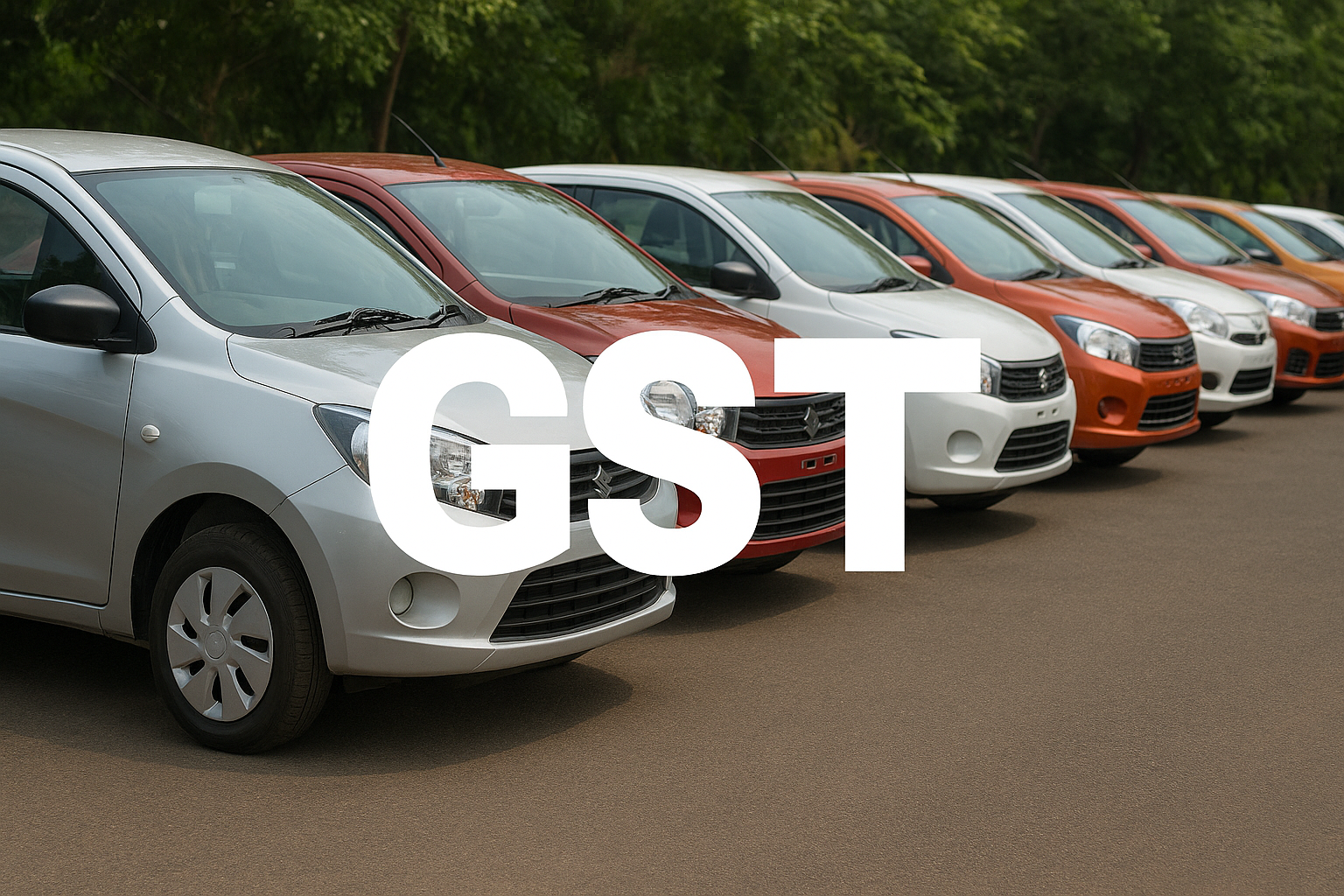
The Ministry of Heavy Industries has issued a directive to all automobile manufacturers, including carmakers and two-wheeler producers to prominently display posters at their dealerships showing price comparisons before and after the recent Goods and Services Tax (GST) rationalisation. According to Business Standard, the directive, routed through the Society of Indian Automobile Manufacturers, specifies that the posters should also feature a photograph of the Prime Minister. Automakers are now designing these posters and seeking ministry approval before proceeding with printing and distribution.
Context: GST 2.0 Sparks Auto Industry Shake-Up
Earlier this month, the GST Council unveiled sweeping reforms in indirect taxes, introducing a streamlined, two-slab structure and lowering GST rates for most passenger vehicles. Small petrol, LPG, or CNG cars with engines up to 1,200cc and length under 4,000mm now attract 18 percent GST instead of previous higher rates; similarly, smaller diesel cars fall under the same tax bracket. Larger vehicles, luxury models, and SUVs comprise a special 40-percent GST slab. This reform has effectively eliminated the earlier compensation cess that pushed overall taxation higher.
GST on luxury cars has been simplified too, with high-end vehicles now taxed at a flatter 40 percent—down from combinations that exceeded 50 percent earlier. The simplified taxation structure aims to boost affordability and demand across segments.
Market Repercussions: Consumers Wait, Automakers Respond
The tax overhaul had immediate market impact. Major automakers reported declines in vehicle dispatch to dealers in August as buyers delayed purchases in anticipation of price reductions. Companies like Maruti Suzuki, Hyundai, Mahindra & Mahindra, and Tata Motors noted year-on-year declines in dispatches ranging between 8 and 11 percent. Automakers intentionally held back new billing to manage deal inventories ahead of GST reforms becoming effective.
In response, several manufacturers announced price cuts to pass on the full benefit of GST rationalisation directly to consumers. Mahindra & Mahindra confirmed reductions up to ₹1.56 lakh across various models, while Tata Motors declared cuts ranging from ₹75,000 to ₹1.55 lakh starting September 22. Other players, including Renault, BMW, and Maruti Suzuki, followed suit with similar announcements.
Dealers’ Concerns: Compensation Cess Credit Buffers at Risk
While consumers anticipate lower prices, dealers face challenges. Removal of the compensation cess — previously charged on luxury segments — has left them with unutilisable credit in their compensation cess ledgers. The Federation of Automobile Dealers Associations (FADA) estimates this credit amounts to approximately ₹2,500 crore.
Dealers have petitioned the Finance Ministry, the revenue secretary, and the chairman of the Central Board of Indirect Taxes & Customs, requesting a transitional mechanism that allows them to transfer these credits to regular GST ledgers—either CGST or IGST—for utilization. Without such support, dealers risk working-capital disruption and potential losses.
Manifold automakers have stepped in to ease the situation. Mahindra & Mahindra, in addition to their price cuts, offered relief to dealers to cushion the impact of the cess removal. Other brands indicated they would follow suit with incentives or discounts aimed at reducing stock buildup until a credit-resolution mechanism is established.
Significance and Outlook
The requirement for dealerships to visibly display GST-related posters—featuring price comparisons and the Prime Minister’s photograph—serves multiple objectives. First, it ensures transparency for consumers, clearly communicating how the GST reforms translate into savings on vehicles. Second, it reinforces government messaging about the reform’s benefits.
From a broader perspective, GST 2.0 is poised to reshape the auto market landscape. Analysts anticipate a sharp uptick in demand, especially for entry-level vehicles, thanks to lower tax incidence. Market data already reflect heightened consumer interest. While dealers currently navigate financial and inventory challenges, demand is expected to surge as the festive season aligns with the GST rate implementation.
Ultimately, the collaboration between manufacturers, dealers, and government signals a concerted effort to manage this transition in a balanced, consumer-centric manner—laying the groundwork for a robust rebound in one of the country’s most vital economic sectors.
For more stories click here
Follow us for latest updates: