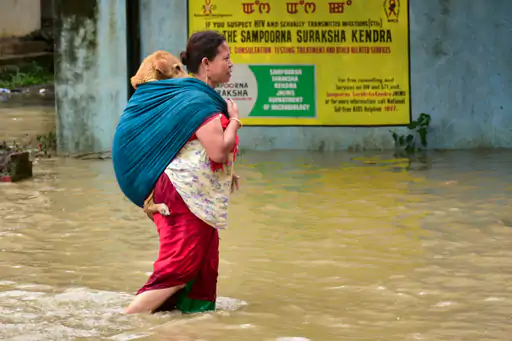
Cyclone Montha has brought life to a near standstill across India’s eastern coast as it barrels toward landfall along Andhra Pradesh late Tuesday evening. The severe cyclonic storm, swirling over the Bay of Bengal, is expected to hit between Machilipatnam and Kalingapatnam near Kakinada, packing wind speeds of 90 to 100 kmph and gusts up to 110 kmph. According to Mint, the India Meteorological Department (IMD) has sounded red alerts for coastal districts of Andhra Pradesh and Odisha, warning of extremely heavy rainfall, rough seas, and high-velocity winds.
Air and rail travel across the region have been severely disrupted. More than 50 train services have been cancelled by the South Central and East Coast Railways as a safety precaution. Several domestic flights to and from Visakhapatnam, Vijayawada, Rajahmundry, and Chennai have been grounded or diverted due to adverse weather conditions. At Chennai airport, at least nine IndiGo flights, including six arrivals and three departures, were cancelled, while operations at Visakhapatnam and Vijayawada airports have been scaled down amid deteriorating conditions.
Coastal districts of Andhra Pradesh, including East and West Godavari, Kakinada, Anakapalli, and Visakhapatnam, are bracing for intense rainfall and strong winds through the night. In Odisha, districts such as Ganjam, Koraput, Rayagada, and Malkangiri are also under red alert. Authorities have begun large-scale evacuations from low-lying areas. More than 1,900 relief camps and 364 temporary shelters have been set up in Andhra Pradesh alone, while tens of thousands of residents have been moved to safer locations.
The National Disaster Response Force (NDRF) and state disaster management teams have been deployed in full strength along the coastal belt. Power utilities and communication departments have been instructed to remain on high alert to ensure quick restoration once the storm passes. Schools and colleges in the affected districts have been closed until further notice, and fishermen have been strictly warned to stay away from the sea.
The IMD has cautioned that sea conditions will remain “very rough to high,” with waves reaching up to 4.5 metres in some coastal stretches. The storm is expected to cause local flooding, uproot trees, damage coastal infrastructure, and lead to temporary communication blackouts. After landfall, Montha is likely to weaken gradually into a cyclonic storm as it moves inland toward southern Odisha and adjoining states.
Heavy rainfall is also forecast in parts of Tamil Nadu, Karnataka, Jharkhand, and Maharashtra’s Vidarbha region over the next 48 hours. Authorities have urged citizens to avoid unnecessary travel and stay indoors, warning that travel disruptions could continue even after the cyclone weakens.
Cyclone Montha has once again exposed the vulnerability of India’s eastern coastline during the post-monsoon cyclone season. With flights grounded, trains halted, and thousands evacuated, the next 24 hours remain crucial. Early preparedness and adherence to official advisories will determine how effectively the region weathers this powerful storm.
Photo Credit: Mint