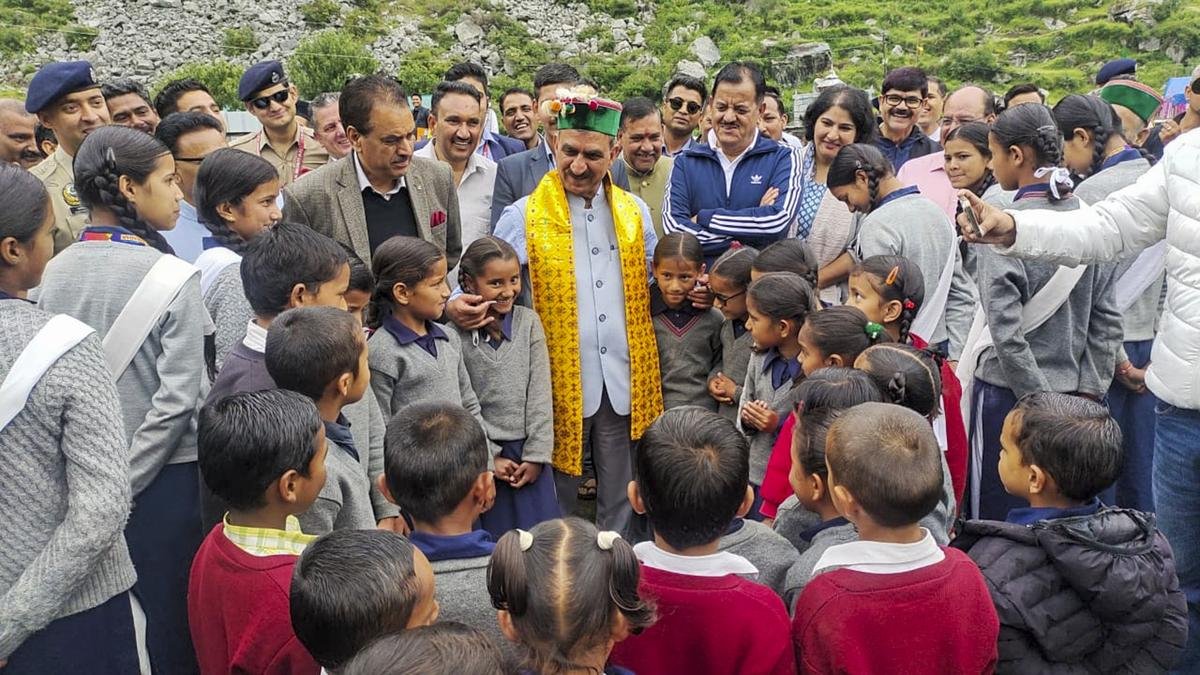
Himachal Pradesh has achieved a remarkable leap in educational performance, climbing from 21st place in 2021 to 5th rank in NAS 2025, marking a dramatic improvement in foundational learning outcomes. This transformation reflects a comprehensive, data-driven overhaul of the state’s education system, reported The Hindu.
The National Achievement Survey (NAS) 2025 results show Himachal earning 2nd rank in Grade 3, 5th in Grade 6, and 4th in Grade 9—a signal of substantial qualitative gains across all levels. These outcomes challenge traditional academic hierarchies and position Himachal as a model for states pursuing educational excellence.
Education officials credit the success to a series of reforms under the Vyavastha Parivartan model, focused on efficiency and equity. A bold move involved shuttering or merging over 1,000 under-enrolled schools, a politically daring action that allowed for better resource allocation and improved classroom environments.
Himachal introduced structural reform by establishing a single school education directorate that oversees all grades up to Class 12, while higher education is administered separately. This realignment reduced bureaucratic overlap and created clearer accountability pathways for implementation.
Another noteworthy policy was the introduction of English as a medium of instruction from Grade 1, aimed at strengthening early language acquisition and long-term employability. The state also allowed schools to adopt their own uniforms to boost student identity and ownership—a psychologically significant measure.
To expose students and teachers to global pedagogic standards, the government rolled out international exposure visits. These trips broadened learning perspectives and brought innovative practices back into Himachali classrooms, reinforcing academic quality and motivation.
Schools were reorganised into cluster-based management units to promote peer learning, shared resources, and stronger supervision. This framework enabled better tracking of performance, peer support mechanisms, and administrative responsiveness at the local level.
Public data validated the policy shift. Under the NIPUN Bharat Mission, Grade 3 students showed consistent improvements in literacy. More notably, government schools outperformed many private institutions—a rare reversal of the national trend—with rural students and girls recording above-average scores. District performance also stood out: Hamirpur and Sirmaur led Grade 3, while Lahaul & Spiti topped in Grades 6 and 9—demonstrating progress even in remote areas.
Still, experts caution that gaps remain. Only about a quarter of teachers participated in continuous professional development programs last year. Infrastructure for Children with Special Needs (CWSN) remains limited in most schools, and vocational subjects struggle to attract student enrollment despite availability.
To break into the NAS top three by 2027, officials propose realigning the state’s educational strategy. This includes embedding competency-based learning practices into school improvement plans, reimagining professional development as continuous rather than episodic, collaborating with industries to make vocational education more aspirational, and expanding mental health support in schools.
Himachal’s educational progress is part of a broader multi-decade journey. From modest diagnostic testing in the early 2000s and integration under Sarva Shiksha Abhiyan, to greater focus on equity by 2012 and district-level assessments by 2017, the trajectory has been consistent. The foundation laid over two decades has made the 2025 leap possible.
The official announcement of the NAS ranking was made in Delhi, where state officials represented Himachal and emphasized that this achievement reflects consistent, reform-driven policymaking and strong on-ground execution.
Why It Matters
Himachal Pradesh’s rise to 5th rank in NAS 2025 underscores a successful governance lesson: bold administrative decisions, rooted in data and equity, can dramatically improve educational outcomes—even in geographically challenging regions. The state now stands as a possible blueprint for others aiming to elevate public education quality nationwide.
Photo Credit: The Hindu
Follow us for latest updates: