Photo Credit: The Hindu
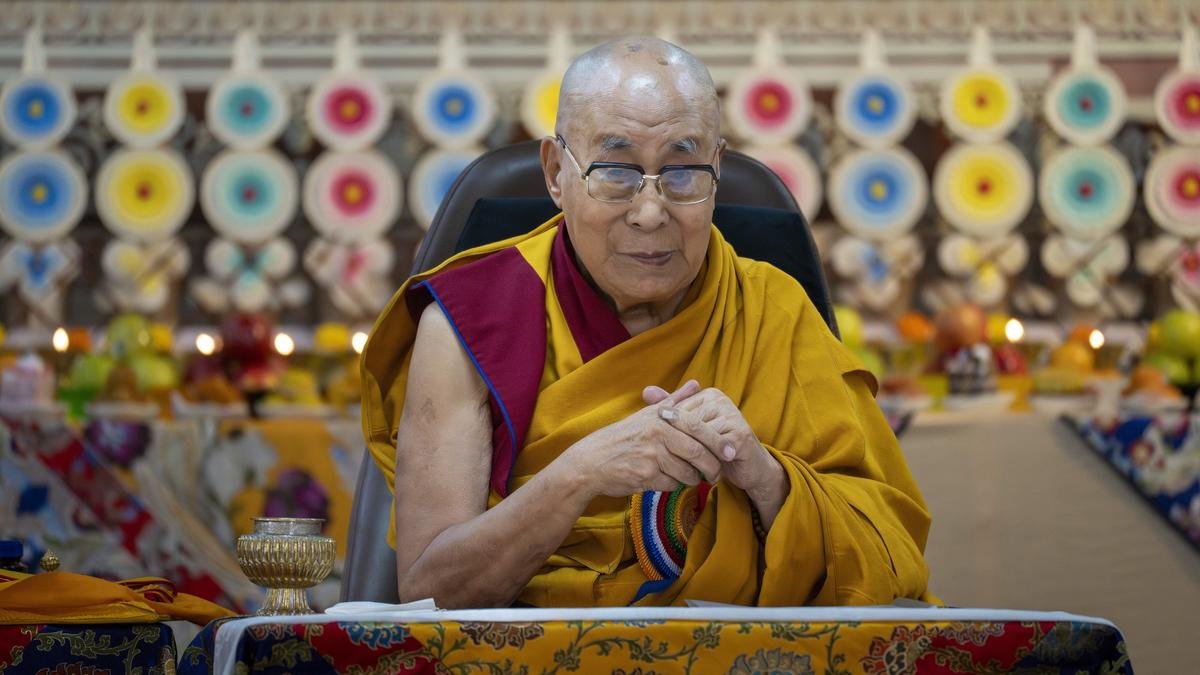
On the eve of his 90th birthday, the Dalai Lama has officially announced that the search for his successor will proceed in accordance with traditional Tibetan Buddhist practices. With this declaration, the long-standing global speculation surrounding the continuation of the Dalai Lama’s spiritual lineage has finally been put to rest, reported The Guardian. The Dalai Lama confirms successor search—a phrase that now dominates headlines—bringing clarity to millions of followers and reinforcing the autonomy of Tibetan Buddhism amid increasing political pressure from China.
In a pre-recorded address to the 15th Tibetan Religious Conference held in Dharamsala on July 2, the Dalai Lama stated that his reincarnation would be identified by the Gaden Phodrang Trust, an organization he established to preserve Tibetan spiritual heritage. The trust, in collaboration with senior monks, will follow time-honored rituals and spiritual practices to locate the next Dalai Lama, entirely outside the purview of any government, especially China.
For years, the Dalai Lama had remained non-committal about the succession, occasionally hinting that he could be the last of his line. However, his recent affirmation has reversed that uncertainty. He made it unequivocally clear that any successor selected under the influence of the Chinese government would not be recognized by the Tibetan Buddhist community. This statement is seen as a direct challenge to Beijing’s efforts to impose its authority over Tibetan religious traditions.
The issue of succession holds not just religious significance but also cultural and geopolitical implications. The Dalai Lama is not only the spiritual head of Tibetan Buddhism but also a powerful symbol of Tibetan identity and resilience. His decision to ensure a legitimate and independent reincarnation process is viewed as an effort to safeguard this identity for future generations.
Traditionally, the reincarnation of a Dalai Lama is recognized through spiritual signs, visions, and a meticulous process led by senior monastic leaders. This includes identifying a child who exhibits unique qualities or memories believed to be linked to the previous Dalai Lama. The current Dalai Lama has reportedly already left behind detailed instructions to guide this process, ensuring its integrity beyond his lifetime.
This move also comes in response to China’s aggressive stance on the succession issue. The Chinese government has long insisted that it holds the sole right to appoint the next Dalai Lama, invoking historical edicts such as the 1793 “golden urn” policy. However, the Dalai Lama’s clear assertion that his successor must be born outside of Chinese-controlled territory effectively nullifies Beijing’s claim and sets the stage for a contested spiritual succession in the years ahead.
The timing of the announcement, just days before the Dalai Lama’s 90th birthday on July 6, adds symbolic weight. It signals a new phase in Tibetan Buddhism—one that seeks to protect its sanctity and independence in a world where spiritual matters are increasingly entangled with political agendas.
Reactions to the announcement have been swift. The Tibetan government-in-exile and global Tibetan communities have welcomed the move, seeing it as a reaffirmation of their religious freedom and cultural dignity. Meanwhile, China has responded with familiar rhetoric, labeling the Dalai Lama’s actions as politically motivated and asserting its authority over any future reincarnation process.
Despite these tensions, the Dalai Lama’s decision has brought a sense of direction and purpose to a community that had long grappled with the uncertainty of his succession. It also underscores a larger message—that the spiritual legacy of the Dalai Lama cannot be dictated by political regimes but must be nurtured through faith, tradition, and the collective will of his followers.
As the world marks the Dalai Lama’s 90th birthday, his message is clear: the lineage will continue, not under the shadow of authoritarianism, but through the light of spiritual freedom. The search for his successor will be guided not by governments, but by the sacred traditions that have sustained Tibetan Buddhism for centuries.