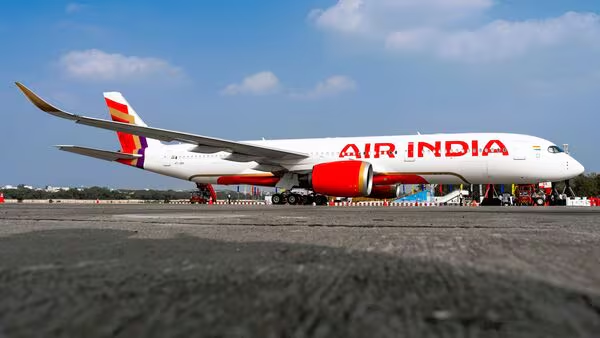
Grounded Accountability: Three Air India officials removed as aviation regulator issues stern licence warning. Photo Credit: Google
In a strong regulatory move, the Directorate General of Civil Aviation (DGCA) has removed three senior Air India officials from their roles following serious crew scheduling lapses. The aviation regulator has also threatened to withdraw Air India’s license if the airline fails to demonstrate full compliance with safety and rostering norms.
The disciplinary action was triggered after DGCA discovered violations related to flight duty time limitations (FDTL), where pilots were allegedly scheduled beyond the permissible hours. These incidents occurred on two Air India flights from Bengaluru to London on May 16 and 17, raising red flags about systemic flaws in crew management.
DGCA Orders Removal of Air India Officials Over Scheduling Violations
According to the DGCA’s order dated 20 June, three key officials—including a divisional vice president and senior rostering executives—were found responsible for “serious and repeated scheduling lapses.” They were immediately removed from their posts and will face internal disciplinary action by Air India.
The regulator warned that repeated violations or failure to take corrective action could result in license withdrawal or operational restrictions for the airline.
“The absence of firm disciplinary action in the past reflects poorly on internal oversight. This will not be tolerated,” said a senior DGCA official.
DGCA Threatens License Withdrawal: A First in Recent Years
The warning marks one of the most serious actions taken against a major Indian airline in recent years. It highlights a growing concern among regulators regarding crew fatigue and scheduling violations, especially in the aftermath of the Ahmedabad Boeing 787 crash earlier this month—though the DGCA has clarified that the two issues are not directly linked.
Nonetheless, the license withdrawal threat against Air India signals a zero-tolerance approach to lapses in safety and operations.
Crew Scheduling Lapses and Emergency Equipment Oversight
While the primary issue was pilot scheduling beyond allowed hours, DGCA investigations also revealed that Air India had operated three Airbus A320 aircraft with overdue emergency equipment checks, specifically related to escape slides. These checks had not been completed for up to three months, a violation of standard operating procedures.
These findings further solidified DGCA’s concerns over Air India’s compliance culture and operational safety protocols.
Show-Cause Notice to Air India CEO
A show-cause notice has been issued to Air India’s Accountable Manager, essentially the CEO, demanding an explanation for the failures within seven days. The DGCA has asked for a detailed report on corrective measures being undertaken.
Air India voluntarily reported the original scheduling errors during a post-transition audit of its Integrated Operations Control Centre (IOCC), but DGCA says the revelations point to deeper managerial and systemic flaws.
Air India Responds, Suspends Key Officials
In response, Air India confirmed the removal of the officials in question and announced that its Chief of Operations would temporarily oversee crew management. The airline released a statement affirming its commitment to “total compliance with safety regulations and crew duty norms.”
“We are cooperating fully with the regulator and have initiated further internal audits,” the airline said.
Owned by the Tata Group since 2022, Air India has been undergoing a transformation push, but this incident puts fresh scrutiny on its internal processes.
Experts Welcome Action, Stress Need for Cultural Shift
Aviation safety experts and industry analysts have largely welcomed DGCA’s action, noting that it may prompt long-overdue reforms in operational transparency.
“The DGCA has drawn a clear line. Flight safety starts with crew management. Any slip here endangers lives,” said an aviation consultant familiar with regulatory audits.
Others believe this incident underscores the need for data-driven crew rostering systems and stronger checks on duty rosters, especially as airlines scale up operations post-pandemic.