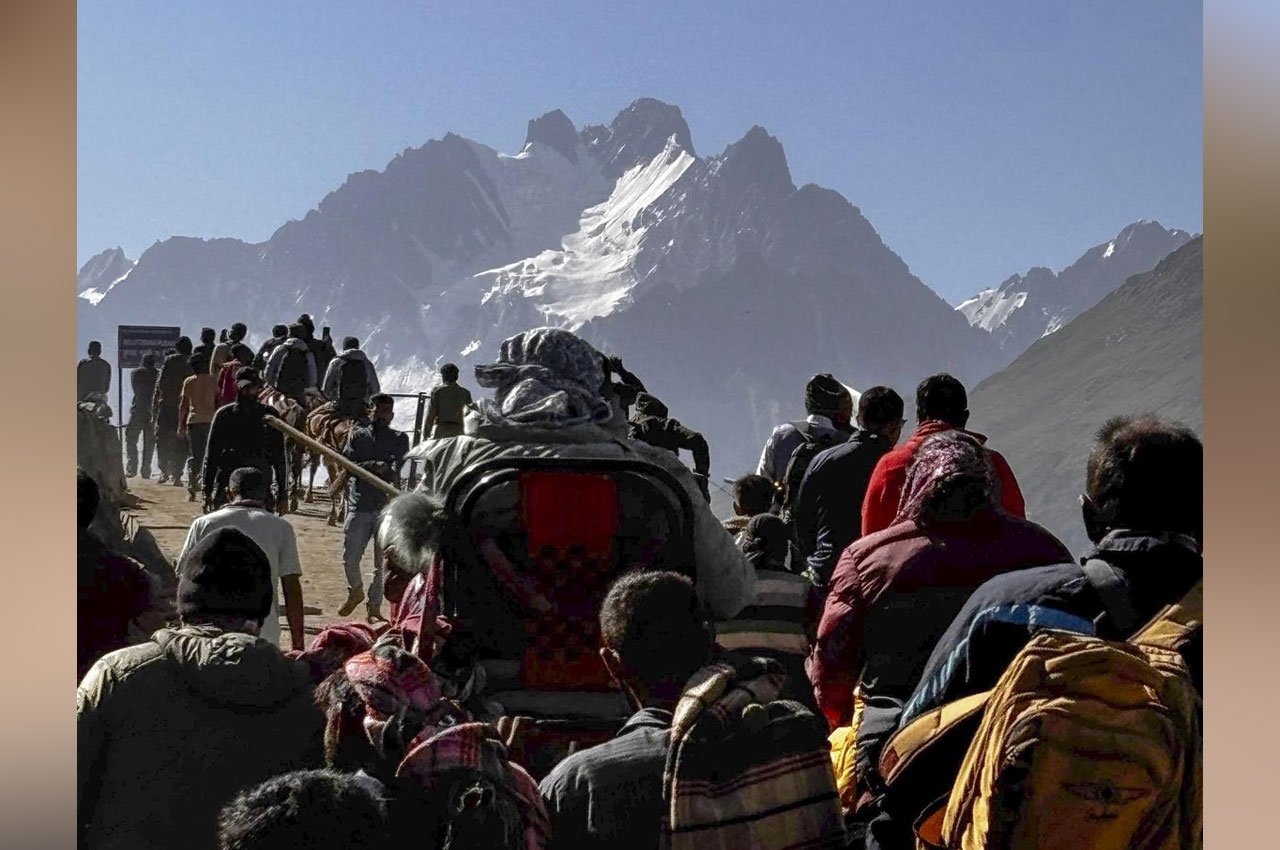
Amarnath Pilgrims Leaves Jammu Base Camp. Photo Credit: The Hindu
A fresh and determined group of 6,979 Amarnath pilgrims left the Jammu base camp for Kashmir early on July 5, undeterred by heavy rainfall and stringent security protocols. This marks the fourth batch of pilgrims in this year’s 38-day annual yatra, with the total number of devotees departing from Bhagwati Nagar in Jammu now exceeding 24,500 pilgrims, according to official figures. According to The Hindu, approximately 30,000 pilgrims have already paid obeisance at the glacier shrine cave since the pilgrimage began on July 3 via the Pahalgam and Baltal routes.
Pilgrim Composition and Departure Details
The fourth batch comprised 5,196 men, 1,427 women, 24 children, 331 sadhus and sadhvis, and one transgender devotee. They departed in two separate convoys between 3:30 am and 4:05 am under multi-tiered security arrangements. Of them, 4,226 pilgrims traveled with 161 vehicles toward the Nunwan base camp on the longer 48-km Pahalgam route, while 2,753 pilgrims took 151 vehicles toward the 14-km Baltal trek to the shrine.
Logistics and Security Measures
Pilgrims for the Pahalgam route typically complete the journey over three to five days, with stops at camps including Chandanwari, Sheshnag, and Panchtarni at high altitudes exceeding 11,500 ft. Baltal pilgrims tackle a steeper, shorter path that spans around eight hours on foot or via ponies. Security has been tightened since an attack on April 22 that resulted in casualties. Multi-layered checks, RFID tracking, and central and state force deployment are integral parts of the safety infrastructure.
Registration and Participation Figures
Since July 3, over 350,000 pilgrims have registered for this year’s yatra through online systems, and 34 accommodation centres have been set up across Jammu. Twelve counters have also been commissioned for instant on-site registrations to manage the surge and streamline departures.
Recent Numbers and Historical Perspective
With this latest batch, 24,528 pilgrims have commenced the journey from the Jammu base, out of a total of approximately 30,000 who have visited the Amarnath cave so far. This pilgrimage to the holy cave shrine, situated at 3,880 meters, typically draws anywhere between 200,000 and 600,000 devotees over its 38-day period, reflecting its spiritual importance.
Weather Challenges and Risks
Despite heavy monsoon showers in the Himalayan region, officials confirmed that the yatra has proceeded without major delays so far. Nevertheless, unpredictable weather remains a significant challenge. Trek routes are often prone to landslides and flash floods, necessitating regular vigilance and coordination between meteorological agencies, disaster response teams, and mountain medical units.
Safety Infrastructure and Health Support
Organisers emphasise the availability of round-the-clock medical aid, shelter tents, emergency evacuation provisions, and helpline services. Resorts and local communities along the routes provide logistics and support. Every participant carries an RFID tag, enabling real-time location tracking to assist in emergency management or search-and-rescue operations.
Economic and Cultural Significance
The Amarnath Yatra not only holds immense religious and cultural importance but also contributes significantly to the regional economy. Local businesses, including pony operators, porters, tea vendors, and transport providers, depend heavily on the seasonal pilgrimage. Previous tragedies, such as the 2017 massacre and the recent attack in April, have heightened community awareness around the yatra’s fragile security environment.
What Lies Ahead
Pilgrims will continue to embark in scheduled batches under escalating security measures. Officials are focusing on ensuring safe passage, especially for the 14-km Baltal route. Weather advisories are in constant effect, cautioning against unnecessary trekking in rain-prone stretches.
The yatra will remain active through mid-August, subject to weather and ground conditions. Organisers remain vigilant to balance spiritual fervour with necessary precautions, underscoring how devotion and logistical planning go hand in hand in the high-altitude pilgrimage.
For more regional stories click here
Follow us for latest updates: